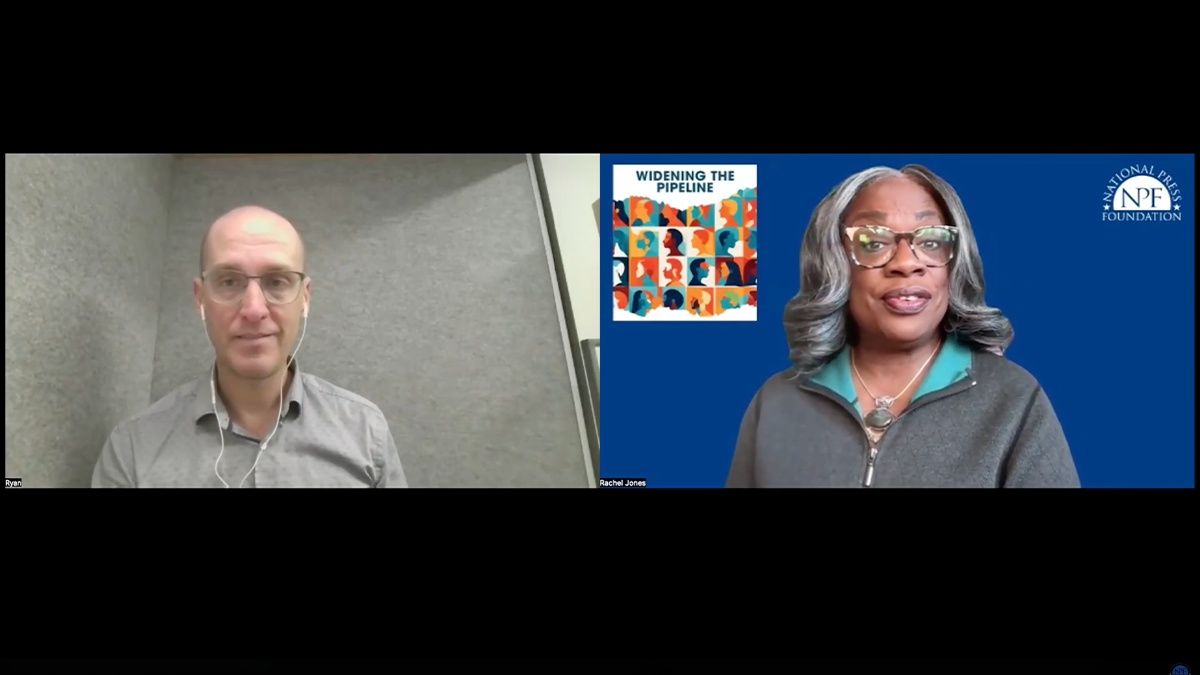
At the February 2026 Widening the Pipeline virtual training, Ryan Restivo, creator of the YESEO app, offered a clear message to journalists navigating artificial intelligence: Be skeptical. Be practical. And stay in control.
Restivo, 2022–2023 Reynolds Journalism Institute fellow, launched YESEO in 2023 as a free, Slack-based tool designed to help reporters and editors strengthen headlines and better understand how their stories perform in search. Since then, it has been installed in more than 600 workspaces and used on more than 18,000 stories.
But even while pitching YESEO, Restivo was careful to celebrate his product while also aiming to reframe how journalists think about AI.
“I want to make sure that I’m hammering home the point that this isn’t going to replace anybody doing really valuable reporting,” Restivo said. “Using tools will help you but not replace your reporting. I think it depends on how you use tools in your work.”
Here are other highlights from Restivo’s presentation:
YESEO: Optionality Over Automation
Restivo built YESEO with one guiding principle: give journalists information, not instructions.
Users paste a story into Slack, select their market, and receive analytics about keyword usage and structure. If they want, they can request suggested headlines generated by a large language model. But the model only reads the story if the user opts in.
“The most important thing for me is that the only time that a model would read a story is when a user permits it to do so,” Restivo said. “Nothing else is being produced without their consent.”
And instead of generating one headline option, YESEO creates multiple options, giving users a curated selection to best suit their story.
“Optionality has always been the important thing for me,” Restivo said. “Maybe this will introduce a word that possibly they didn’t think about before.”
Internal surveys from YESEO show that roughly 70% of users say the suggestions are helpful. But Restivo resists overstated performance claims. He does not collect proprietary click-through data or promise dramatic traffic boosts.
“There are a ton of things out there that are going to tell you they’ve done a zillion percent better over three hours or they’ve saved you 300 hours of time,” he said. “I look at a lot of those things skeptically because I don’t know how they do math to measure most of those things.”
Instead, he pointed to user anecdotes. One example Restivo shared was about a public radio journalist who reported that a YESEO-generated headline led to her station’s highest web traffic in more than a year.
For Restivo, the value is not in replacing editorial judgment but sharpening it.
“It’s about using this information to give people those kinds of ideas… and then they can use their intuition.”
Skepticism First, Innovation Second
Restivo acknowledged the intense hype cycle surrounding AI tools. Referencing the common boom-and-bust pattern seen in other platforms, he urged journalists not to confuse marketing claims with newsroom reality.
“I think it’s good to be skeptical of these things,” he said. “These tools still have a lot more in common with the kind of elements of what we’ve been dealing with for the first few years here than the hype cycle of these things that are going to do everything for you.”
He reminded Widening fellows that automated writing is not new. As early as 2009, companies were generating sports recaps and earnings reports using structured data. What has changed is the scale and accessibility of large language models. But scale does not equal news judgment.
“These systems have been trained on books, but also the internet,” he said. “The internet has a lot of great things, but also doesn’t have a lot of great things.”
Restivo believes that makes human oversight non-negotiable–especially in journalism, where underreported communities and biased datasets can distort coverage if tools are used uncritically. As the session wrapped up, Restivo made it clear that his long-term goal is not disruption for disruption’s sake.
“YESEO exists to help people with their stories,” he said. “It’s about setting goals… and continuing to figure out ways to serve people well, and hopefully that’ll lead to a great future.”
In an era crowded with AI promises, that measured approach may be the most innovative move of all.
Access the full transcript here.