When Lisa Desjardins arrived on Capitol Hill more than two decades ago, the congressional correspondent recalled a time when Senate and House leaders regularly huddled with the press corps for cordial, even friendly, backgrounders that opened valuable windows into legislative strategy and politics.
Those times are rare, if not distant memories.
A riven political landscape, increasingly featuring “bare-knuckle” tactics, has not only changed the legislative process but also how the press interacts with lawmakers, PBS NewsHour’s award-winning correspondent told the National Press Foundation’s Paul Miller Washington Reporting Fellowship class.
“It really is more Wild West,” Desjardins said. “The usual paths for getting things done or not getting them done … are kind of being thrown out the window.”
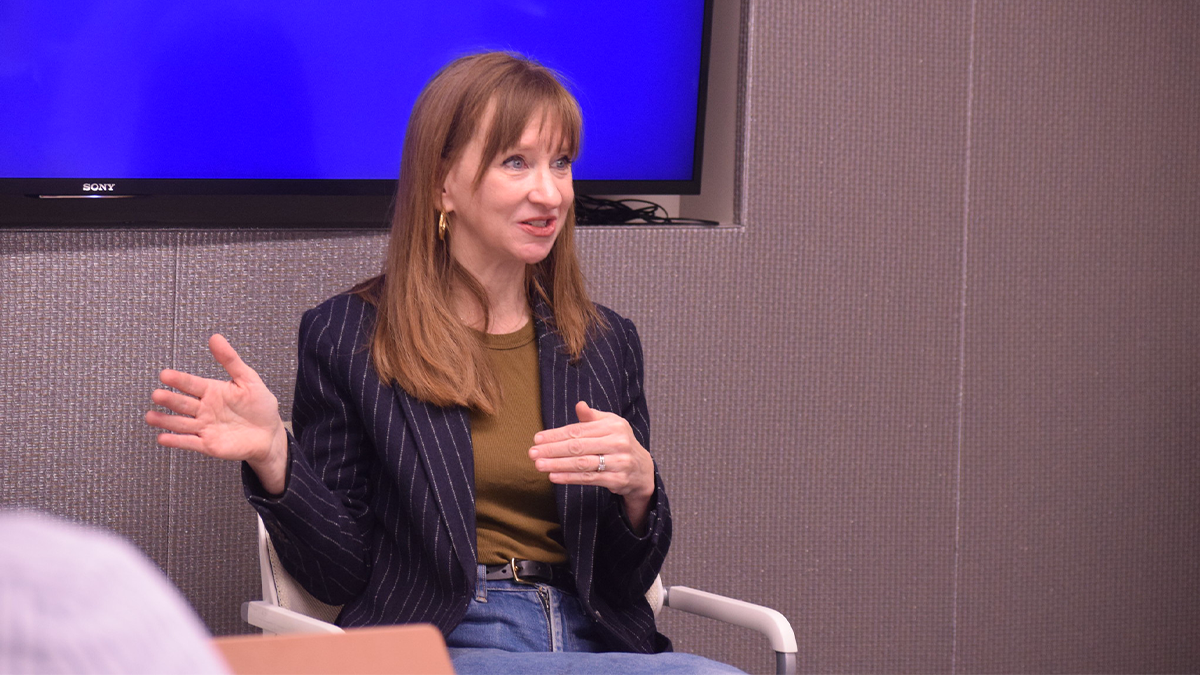
The uncertain environment, now marked by a razor-thin Republican majority, is requiring reporters to reassess their approach to the work of building reliable contact networks with lawmakers and their staffs, Desjardins said.
“I think I’ve become more agile… because you’re constantly looking over your shoulder,” she said. “You’re constantly thinking, ‘Who are the younger members who are smart who I can trust? Who (do) I want relationships with who have an ear to the ground that are being overlooked? Who is someone that could cause a lot of trouble for someone else down the road or could be a fly in the ointment’ ”
“Anyone can be the newsmaker at any time,” Desjardins said, referring to tight vote margins. “You have to constantly wear high tops in your mind.”
She described the current Trump term as similar to the first with governing and reporting taking on the theme of “predictable chaos.” Covering the hardball nature of politics can often test the strongest reporter-source relationships.
But Desjardins urged journalists to “stand your ground.”
“People can be really nasty and mean to you if you do a story that (they) don’t like, and you just have to wait it out,” she said.
And when attempting to connect with essential sources, Desjardins advised reporters to be “unrelenting,” describing a long pursuit of a contact.
“I’m not kidding you, I texted this person every week and sometimes more than once a week for a year and a half, and they never texted back that whole time,” she said. “Nothing, nothing. And then out of the blue they did.”
Desjardins said she learned to approach source-building by humanizing the process, attempting to break through what can be cold exchanges of texts and emails.
“The more human you can get with these sources, and that doesn’t mean panting like a puppy, but if you can get on that human level, be true to your personality, what works for you.. that makes a huge difference.”
In the end, Desjardins urged reporters to expect the unpredictable, especially when attempting to decipher Trump administration strategy.
“He (Trump) lets people think what they want to think. He is very good about leading on lawmakers into thinking he is making them a promise when he hasn’t. So (Illinois Sen.) Dick Durbin used to call it, ‘Which Trump is it? Is it Tuesday Trump or Wednesday Trump?’
“It’s Trump. Be ready. You don’t know what is real.”