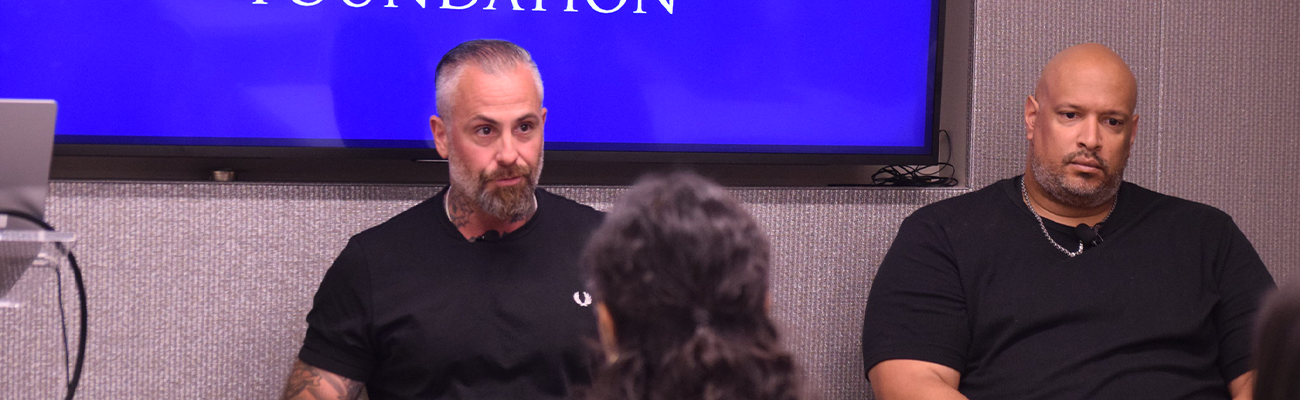
Michael Fanone and Harry Dunn know what a public safety emergency looks like in Washington, D.C.
Outnumbered and over-run, the two D.C.-area police officers were viciously attacked when a violent mob sought to seize the Capitol in a stunning attempt to halt the certification of Joe Biden’s election on Jan. 6, 2021.
What prompted President Donald Trump to dispatch the National Guard and federal law enforcement to the city’s streets last month, the former officers said, looked more like a naked power grab than a public safety crisis.
“If there’s one thing left in this country that should be sacred, it is the idea that law enforcement is not politicized,” said Fanone, a former Metropolitan D.C. police officer, who was nearly killed during the Jan. 6 insurrection. “I hate it when politicians say they back the blue. I would rather you just pass legislation to support law enforcement and shut the f__ up because every time you open your mouth from one side of the aisle or the other, it makes my job that much more difficult in going out into the community and interacting with people, even if I don’t espouse any type of relationship with a political party.”
Fanone told the National Press Foundation’s Paul Miller Washington Reporting Fellowship program that the administration’s action featuring masked immigration agents in tactical gear and heavily armed soldiers “creates a significant danger to the public.
“If you end up with some 18-year-old kid that’s running around with an AR-15 and a handgun and all of a sudden sees something happen, doesn’t have the training to deal with it appropriately as a domestic law enforcement officer does, and then all of a sudden John Wayne comes out and we end up with a Kent State scenario,” Fanone said.
Dunn – a former U.S. Capitol police officer who, like Fanone, testified before Congress – said the presence of ICE and soldiers undermines local law enforcement’s already fragile relationship with the communities they serve.
“Even before this whole Donald Trump thing, there was always … especially in Black and Brown communities, no trust,” Dunn said. “Nobody liked law enforcement and it was just not a good relationship. But I came to realize we need the police officers.”
There already are signs of troubling breaks in trust.
Public demonstrations have called for an end to the federal occupation, while local grand juries, comprised of D.C. residents, have recently refused to charge defendants swept up in the federal crackdown – strikingly rare actions by any measure.
“There’s a ripple effect to that,” Fanone said, adding that a lack of public confidence can contribute to a “complete breakdown of the criminal justice system.”
“And that is incredibly dangerous. And unfortunately (that’s) what I see is the end result from what’s happening in the district right now,” Fanone said.
The administration, meanwhile, has claimed more than 1,000 arrests during the past month. But the former officers said the overwhelming numbers involve public nuisance and misdemeanor offenses. In 2024, Washington, D.C. saw its lowest level of violent crime in 30 years, according to the Justice Department.
“If we’re scaring our way into safer communities, that’s not sustainable,” Dunn said.
Access the full transcript here.