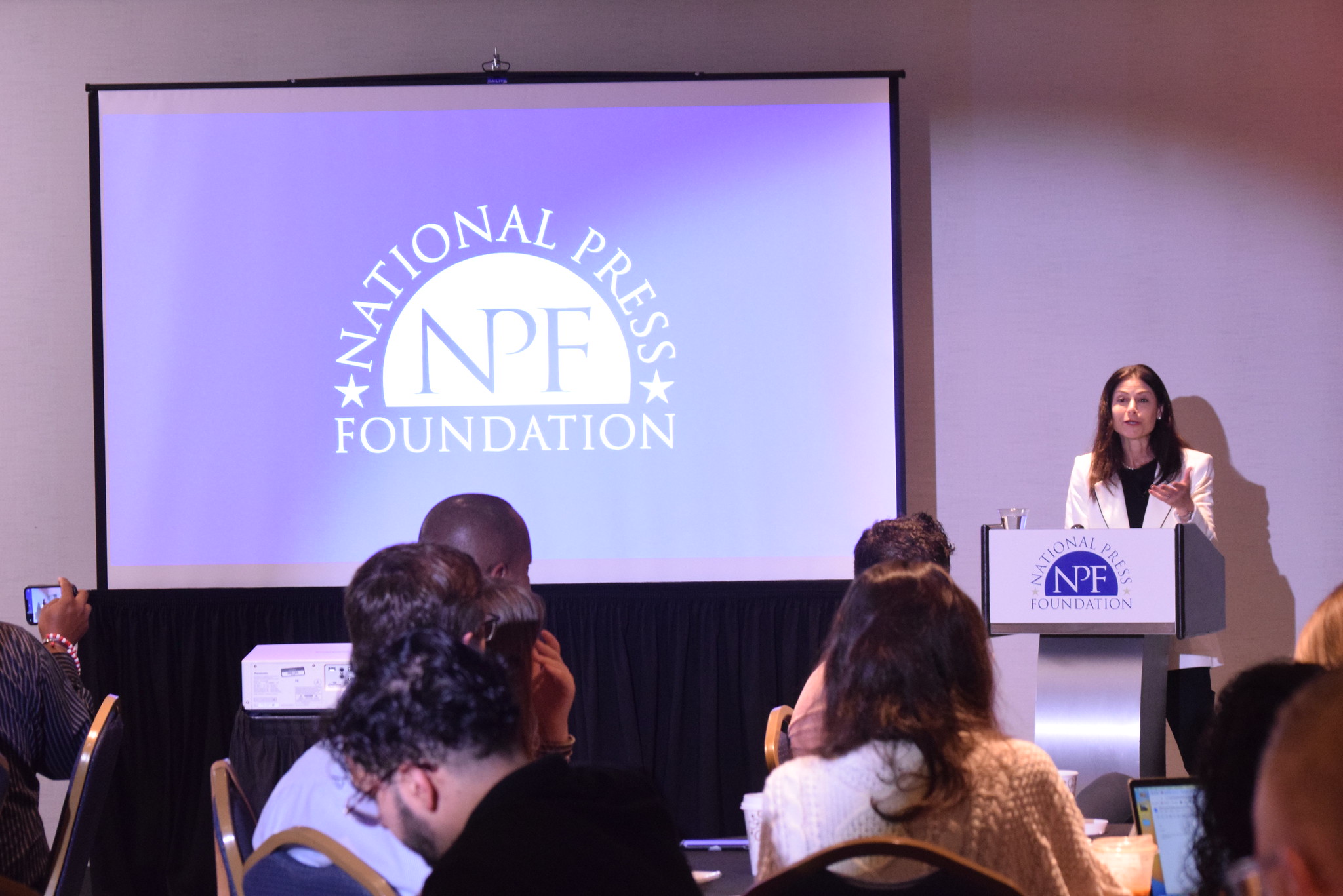
Michigan remains on the frontlines of a continuing fight against misinformation and efforts to undermine public trust in government less than 100 days before the 2024 election, state Attorney General Dana Nessel told the National Press Foundation’s 2024 Elections Fellows.
Nessel said officials are bracing for an onslaught of misinformation, drawing on the post-election events of four years ago when armed protesters marched into the Michigan Capitol in 2020 in an act that Nessel called a “dress rehearsal” for January 6, 2021 assault on the U.S. Capitol.
The attorney general called on journalists to do their part to hold the line against disinformation and other attempts at election interference.
“The worst form of misinformation involves a false time or place or manner of voting so that it discourages or makes it impossible for people to vote on or before election day … It’s why your job is all the more important so that you are out there spreading accurate information.”
Combating the ‘bad actors’ in the 2020, 2024 election
In 2020, Nessel said the state was forced to defend a lawsuit that was trying to overturn Michigan’s election result, part of a campaign waged by Texas Attorney General Ken Paxton.
“We held strong to our convictions, and we did not permit their frivolous efforts to upend democracy, but we did have to spend a significant amount of our precious limited state resources fighting back against a torrential downpour of frivolous lawsuits that followed the 2020 election.”
“One of the things that bothers me so much is they’re all still practicing. Nothing happened to them, nothing happened to their law licenses, and many of them are still in the process of being engaged in filing frivolous lawsuits, and I think we’re going continue to see many of those bad actors play a role in the 2024 election.” She mentioned that Stefanie Lambert has been charged, but still has her license, as does Sidney Powell.
‘Gray area’ in election intimidation
When it comes to prosecuting cases of election interference, the legal ambiguity of the situations can make things difficult. Groups often use tactics that are just barely legal — taking advantage of open carry laws to make election workers feel threatened, without actually making direct threats.
Nessel said that her office works directly with election clerks to let them know which behaviors are actually criminal in the hope that they will be better prepared for any threats in future elections and that she’s “not afraid” to charge individuals with terrorism when there’s evidence.
Free press crucial to democracy
“Freedom of press is often the very first thing to go when a nation descends into authoritarianism … It’s a slippery slope. It begins with suppression of the media,” Nessel said.
Nessel referenced the book, “So Many Enemies, So Little Time,” a memoir from an American professor who taught journalists in Kyrgyzstan after the fall of the Soviet Union. She described the difficulties in teaching journalism to a populace that was used to very little freedom of the press. Nessel pointed out that an American population that is disillusioned with the media and their government might face similar issues.
“It’s a heavy responsibility to figure out exactly what’s going wrong and to make sure everybody knows about it … and I’d say doubly so if you are reporting for a population that’s too disillusioned to address their problems.”
Access the full transcript here.
This program is funded by Arnold Ventures. NPF is solely responsible for the content.