The National Press Foundation (NPF) and the National Press Club Journalism Institute (NPCJI) have jointly awarded $45,000 to fund four reporting projects on environmental justice. This is the third year that the two leading journalism organizations have partnered to fund investigative environmental justice journalism.
Each of the following grantees will receive $11,250 to fund their project:
Jena Brooker, BridgeDetroit. Brooker’s five-part series project explores the impacts of Michigan’s Air Pollution Control Exemption, which exempts some of the state’s worst violators of air and water quality laws from sales, use, and property taxes. Brooker seeks to identify how much this law has cost Detroit in lost taxes which would have otherwise been used to fund city services and the impact of excess emissions from the exempted facilities in question. After publication, she will create a physical fact sheet to distribute to Detroit residents, of which 300,000 lack broadband internet access.
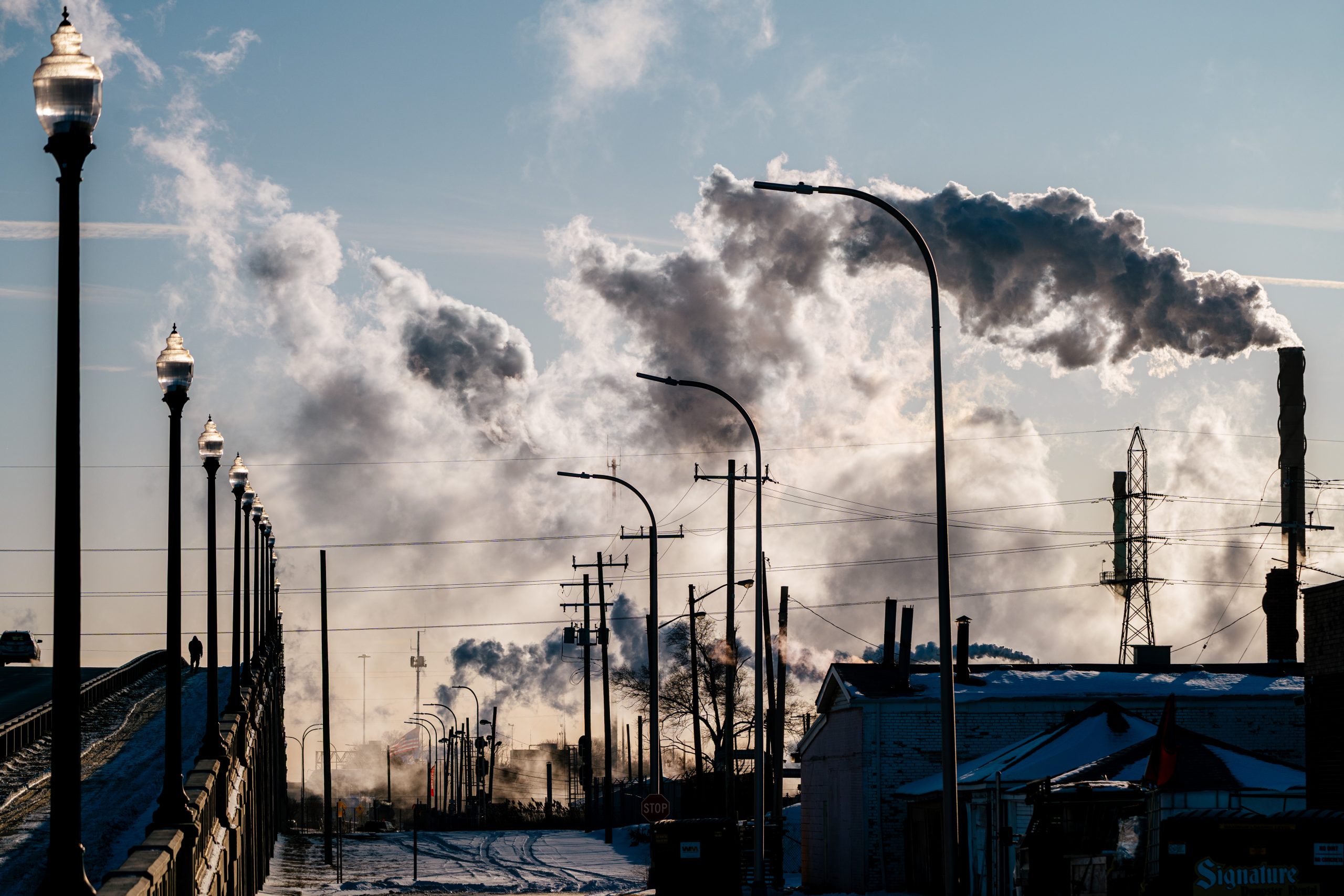
The Marathon Detroit Refinery near the Rouge River on Jan. 23, 2026. Photo Credit: Nick Hagen for BridgeDetroit
Rob Chaney, freelance/formerly of the Missoulian. Chaney’s project will examine the differences among Indigenous and other communities in transitioning from coal to renewable energy sources, with a focus on three neighboring communities: the Northern Cheyenne Reservation, Crow Nation, and the town of Colstrip. It will explore the different ways mainstream and Indigenous cultures respond to climate change and will compare the energy-economy transition plan of Colstrip to the proposals offered on the reservations. In addition to appearing in the Missoulian, the published work will be made available to Indian Country Today and its affiliates and Lee Enterprises outlets across the U.S.
Chaney’s first part of the four-piece series takes readers across the landscape shared by the Northern Cheyenne, Crow and Colstrip residents who live above the United States’ largest coal reserve, and lays out the challenges and uncertainties entangled in envisioning a new energy economy. Chaney’s second part of the series highlights the impact of money, power, politics and tradition of the coal country’s future. Chaney’s third part of the series covers the Crow, Colstrip and Northern Cheyenne communities bracing for waves of change in Montana’s renewable energy transition. Chaney’s fourth part of the series highlights a visual tour of Montana’s coal country and the people and places that have grown up around it.

The Absaloka coal mine just north of the Crow Indian Reservation provided royalties that supported about 1,000 tribal government jobs. It ceased production in April 2024 after its last customer ended its contract. Credit: Ben Allan Smith / Missoulian
Celeste Gracia and Aaron Sánchez Guerra, North Carolina Public Radio – WUNC. This three-part audio and digital project will focus on labor conditions for outdoor workers in North Carolina as climate change exposes them to higher temperatures. Gracia and Sánchez Guerra will explore the state’s current and historical political climate as it relates to labor and recent calls by labor advocates for a statewide heat standard. Among those affected are immigrant farm workers, construction workers and airport workers.
Their series, “Scorched Workers,” examines the impact of rising heat on outdoor workers and explores the role worker protections is having in this year’s race for North Carolina’s labor commissioner.

Photo Courtesy: WUNC
Lue Palmer, freelance. Palmer will investigate the impact of noise pollution on the health of a community in Independence, Louisiana, where residents attribute a spate of recent deaths to relentless late-night noise from sixteen-wheel trucks traveling to and from a nearby dump and gravel pit, seven nights a week. Palmer plans to produce – in both print and long-form audio – an investigation into the final months of the people who died and document what nights are like in the mostly Black homes that line the road to the gravel pit.
Her first story, published Oct. 16, details studies that support the effects of ongoing noise pollution and personal accounts from people who suffer from this along Hano Road in Louisiana.

Melvin Jennings, a 77-year-old Vietnam War veteran, says he can’t recall the last time he and his wife slept through the night because of the frequency of large trucks passing in front of their home in St. Helena Parish. (Lue Palmer for Louisiana Illuminator)
“Environmental racism is a critical issue that deserves the attention of these thoughtful and hardworking journalists,” said Anne Godlasky, president of the National Press Foundation. “We’re thrilled at the diversity of topics and communities covered in these projects. Each is a story that needs to be told and we’re grateful to support this work alongside NPCJI.”
Beth Francesco, executive director of the National Press Club Institute, said:
“Each of these projects will investigate and bring context to serious issues impacting vulnerable communities. We are proud to support this work and hope these stories will inspire others to closely examine environmental justice issues in their own backyards.”
The Kozik Grants are funded by a 1991 gift from the late Dr. Franklin Kozik in honor of his deceased son Robert Kozik. The four grantees were selected by judges Antonia Juhasz, Yanick Rice Lamb, Charles Self and Harriet Washington. This is the third round of grants awarded since 2021. See the 2022 Kozik grant recipients’ projects and the 2021 Kozik grant recipients’ projects.
About The National Press Foundation
The National Press Foundation is a nonprofit whose mission is to “make good journalists better.” We educate journalists on the complex issues of the day and train them to use the latest reporting tools and techniques. The foundation recognizes and encourages excellence in journalism through its awards and fellowships.
About the National Press Club Journalism Institute
The National Press Club Journalism Institute promotes an engaged global citizenry through an independent and free press and equips journalists with skills and standards to inform the public in ways that inspire a more representative democracy. As the non-profit affiliate of the National Press Club, the Institute powers journalism in the public interest.