The average length of time needed to identify a rare disease is about five years, and many families wait for more than a decade for confirmation. Often, that painful diagnostic odyssey begins at birth, when a parent receives the results of a blood spot screening test for newborns. But this vital test is not guaranteed for all infants, and countries like the U.S. are scrambling to address this gap.
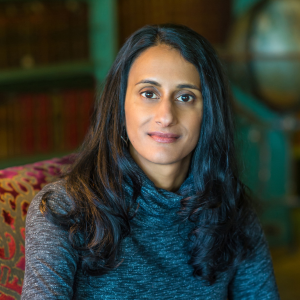
Rare disease researchers and advocates agree about the critical role that newborn screening plays in accelerating progress. And journalists can help explain the public health benefits of early screening for families and communities. On Nov. 16, 2023, National Press Foundation fellows were briefed by Washington Post columnist Bina Venkataraman, health equity advocate Chris Espersen and Chris Porter, vice president of government affairs and policy for Travere Therapeutics.
A holistic view from the moment of birth
For Venkataraman, the diagnostic odyssey involved her seven-year-old niece. While describing her, Venkataraman urged journalists to remember that for families, people living with rare diseases are more than the sum of their physical challenges. “She’s a delight. She uses a lot of facial expressions and physical expressions to express herself to compensate for some of the developmental issues. She’s not as verbal as other kids her age. She’s not as able to articulate herself in other ways, and that leads to a lot of really great physical comedy.”
But the lighter moments were clouded by the struggle to identify her niece’s condition–Prader-Willi syndrome. “There were a lot of doctors early in my niece’s life that told her there was nothing to worry about,” Venkataraman said. “It was her (Venkataraman’s sister) second child, which I think helped her confidence in knowing that this child was different than the child before.”
“We suspect, and it’s hard to write about this, though I hope to find a way at some point, that some of it was also just racial bias or the bias of discrimination in diagnosis. Because one of the symptoms of Prader-Willi syndrome is having lighter skin, and she did have significantly lighter skin than her sister and her parents.”
“But I think because our baseline skin tone is darker than a lot of the patients that these doctors were seeing with the syndrome, that was a bit of a blind spot as well.”
Through Venkataraman’s professional contacts, she was able to get her niece’s genome sequenced, though it’s not routinely done across the U.S. “The list of what you actually get screened for depends on the state you live in, which is one of these Byzantine feudal systems we have here in the US.”
Through a network of Boston-based scientists and researchers, her niece’s condition was finally identified. “She was getting CAT scans and all kinds of things because she had these neurodevelopmental delays. There were a lot of different signs that there was something not right, especially as she got older that became more and more apparent, even with her genome. So the piece I wrote about genome sequencing, that actually wouldn’t necessarily have helped my niece, but genome sequencing can identify obviously all of these different diseases that are caused by single gene mutations.”
Venkataraman believes that if routine genomic screenings were more widely available, a lot of suffering for children could be prevented. “We could detect a lot of diseases and it could help in cases like my niece’s as well and many others where there’s not a single gene mutation or we don’t understand yet the genetic buttons that lead to it.”
An Emotional Odyssey
Chris Espersen’s journey toward a career in health equity and social justice began after one of her best friends from high school was diagnosed with thalassemia, a blood disorder that occurs when the body doesn’t make enough of a protein called hemoglobin, an important part of red blood cells. Untreated, it can lead to heart failure and liver problems.
Watching her friend’s struggles led Espersen first to a degree in pharmacy and then to a 20-year career in health advocacy, culminating in her current work with the National Association of Community Health Centers. Her friend eventually succumbed to thalassemia, but shortly afterward, Espersen gave birth to a daughter with the same disease.
“When she was born in July of 2014, she had a blood spot test. And so I’m very grateful for that blood spot screening to identify some of these rare diseases. At the time, it took a couple of weeks for the test to come back. It actually showed that she had hemoglobin E disease, which I had no idea what that was.”
After some research, Espersen said she had a gut instinct that this diagnosis was wrong. “When you’re that age or when the child is that age, you have to go back to the doctor a lot. Her doctor was telling me that I needed to give her iron supplements because her iron was low. I refused to do that. I had felt that she had thalassemia like my best friend did.”
“And so she would call me every couple of weeks when we had to go in for the other tests, she would call me non-compliant, she would threaten me. She’d say I was a bad mother, and it was really hard to go back. But I just felt that I needed to continue to return. At nine months she went in and they took two vials of blood. My daughter is very strong. I heard other children screaming in the waiting room in their rooms. She didn’t even blink at the doctor. They took the blood, and went back.”
“That’s when thalassemia was confirmed. “And so when I returned to the doctor, I said, ‘Hey, it’s thalassemia like I thought, and you understand why the iron supplements that you wanted me to give her would’ve been harmful to her?’ And she shortly acknowledged it, didn’t apologize, but over the course of her seeing my daughter, I felt that she got to know the disease a little bit better. But again, it was the blood spot screening that started our journey and we are really able to advocate for her just because of myriad circumstantial issues and get her the care that she needed.”
When the professional is personal
Chris Porter had worked on Capitol Hill for 10 years before leaving to start his own consulting company. At that time, he also took a blood test that revealed some concerning results about his liver functioning. “And that led to a five-year journey of misdiagnosis, diagnosis and then deterioration where I ultimately received a liver transplant. I’m one of the lucky ones because I was able to get a liver transplant.”
In his current role as vice president of government affairs and policy for Travere Therapeutics, Porter is constantly in touch with families who battle multiple challenges during the quest for answers and resources for their loved ones with rare disease.
“This December is the 10-year anniversary of the first time a disease called adrenoleukodystrophy was approved for newborn screening. So all the ALD families, put all this time and effort in to begin screening. But yet here we are 10 years later and there’s still 13 states in the US that are not screening for it. So we have a validated test, we have a treatment, we know it can save these lives, but there’s still 13 states where if you live there and your child has this disease, they might die. But if you live in another state they’re going to live. So that’s something called death by zip code, and it’s one of the big, it’s just one of the biggest barriers.
The other thing with all the discussion about genetic testing and incorporating that in newborn screening, that is really an enormous health equity issue. Because right now, as I just said, because of death by zip code where you live makes a difference in whether or not you’ll get screened. You can be on the opposite side of a river and one child will be found and one not. But if you also, more and more families are doing, as has been said, genetic testing on the side.”
“So if what we risk is having a two-tiered system where you live and your resources will make an increasing difference and we’ll lose the public health component of newborn screening if we don’t try to modernize it.”
“Back when we realized that the system was so segmented, we needed to make a case for change. We were one of a few companies and a few patient groups which did a study of the entire newborn screening system, and it made the case and showed that throughout the entire system, even though it’s incredibly segmented, everybody thinks, literally everybody thinks change is needed. And most people think it needs huge change.”
“And part of this goes to the way that the law works in the US. But there’s really every part of newborn screening from the patients who try to raise the research, to do the initial studies to prove that a condition should be screened to the bureaucratic and archaic government process for getting that approval, to the state implementation, to the follow-up that’s done by the labs and then the connection back to the healthcare system. None of these people talk to each other, but everybody knows that the current system isn’t working and it’s not ready for all the therapies that are coming.”
Access the full transcript here.
This program was sponsored by Fondation Ipsen. NPF is solely responsible for the content.




 Reload document
 Open in new tab