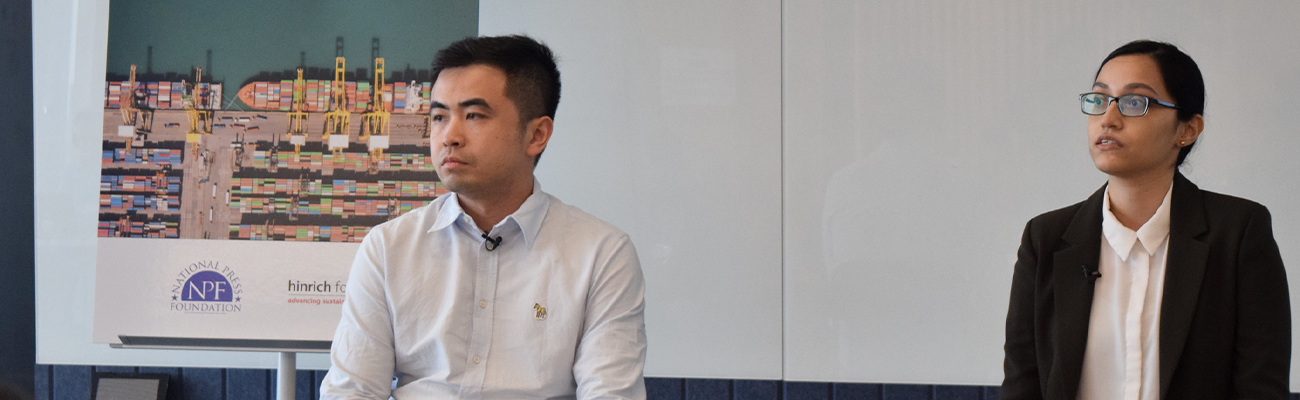
The dramatic numbers tell the story of China’s surge to economic superpower: In just two decades, China has upped its claim on world manufacturing from five percent to more than 20 percent. This expansion, which experts have dubbed “China shock,” has had permanent effects on some labor markets in other countries. Sanjana Goswami, a professor at the Lee Kuan Yu School of Public Policy, and Jing Wu, a professor at the Chinese University of Hong Kong and associate director of the Asian Institute of Supply Chains and Logistics, discuss China’s current economic role in Asia and across the world. [Transcript | Video]
5 takeaways:
➀ Joining World Trade Organization wasn’t the only reason for China’s growth.
Some have suggested that China’s surge was linked to joining the WTO, but Goswami said most countries had already reduced their tariffs before China entered the WTO. What changed, Goswami said, was the level of economic uncertainty in member countries. “Now the producers in all these countries, they don’t have to wonder whether these tariffs will remain low, whether they will go up,” Goswami said. “So that really helps businesses to make decisions for the long run, which helps them put them on the growth path.”
➁ Altering the job market.
Usually, trade shocks occur when countries reduce their tariffs and new tariffs are negotiated with other countries. “It’s not random, you decide, it’s very intentional…It’s not like a shock coming from outside,” Goswami said.
“Nobody really imagined China would grow like that,” Goswami said. China’s growth also occurred due to a very narrow competitive advantage, as opposed to commodity specialization. The jobs China assumed permanently altered the labor market. For instance, in the U.S., there was no replacement for manufacturing jobs, which “were the high-paying jobs for non-college educated workers.”
China’s strengths are in producing goods uniformly, meaning one of the tradeoffs is a lack of variety in products.
➂ The U.S. responds—but consumers are still paying.
As a way of combatting permanent job losses, the Trump administration began imposing high tariffs, in a shift from its traditional stance. Though the long-term consequences of these tariffs are unknown, consumers are feeling the immediate pain of the higher costs. “In the short run, it appears that the US-China trade war definitely has not reversed the China shock situation at all, and it will not,” Goswami said.
The Biden administration crystallized the approach. Instead of attempting to wholly decouple the U.S. and China, the administration attempted a targeted effort—focusing on select industries. For instance, the U.S. has begun blocking some Chinese technologies to reduce its advantage in the sector.
➃ China’s Indo-Pacific Economic Framework advantage.
The IPEF promotes resilience, supply chain connectivity, fair and clean economies. China’s economy is resilient—despite its harsh pandemic restrictions, its factories recovered quickly. Wu said China’s economy is also highly connected to the digital sphere, and it is a top producer of renewable energy technologies. “At this very moment we cannot have a green economy without China,” Wu said. Politically, though, the U.S. has an advantage, and it is trying to leverage its allies against China.
➄ A new phase of globalization.
“You can just export your standard, your licensing, your technology, knowledge and cross-border financing,” Wu said. For instance, the new Tesla factory in Mexico will have the same standard as the existing Shanghai factory.
Countries like Mexico and countries in the Geoeconomic Buffer Zone have the opportunity to serve as connectors between the competing great powers. “India, Mexico, Southeast Asia and Africa, I think they have the potential to be the new factory in the next decades to come,” Wu said.
*This fellowship is part of an ongoing program of journalism training and awards for trade coverage sponsored by the Hinrich Foundation. The National Press Foundation is solely responsible for the content. All programs are on the record and resources and transcripts from this and previous fellowships are published.




 Reload document
 Open in new tab