The pandemic has had especially negative effects on children and teens. From trauma and isolation to school closures and a change in learning, research reveals a spike in sadness for teen girls, a decline in student performance and enrollment. But perhaps most troubling, hundreds of thousands of students never returned to school once the lockdowns ended.
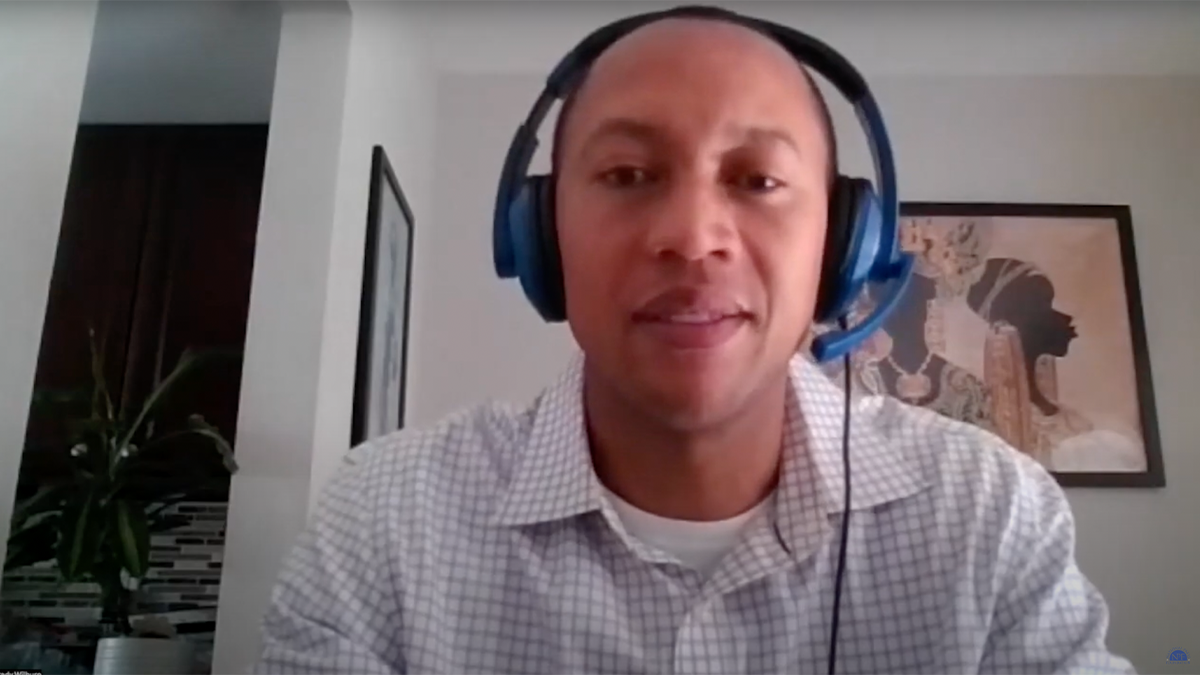
Thomas Dee, the Barnett Family Professor at Stanford University and a Senior Fellow at the Stanford Institute for Economic Policy Research, led a research team including the Associate Press and the Big Local News Project, that analyzed the reasons students are missing from schools post-COVID. He explained the findings to Future of the American Child fellows in Cleveland. [Transcript | Video]
5 takeaways:
➀ There have been “dramatic declines” in student performance.
The National Assessment of Educational Progress – also known as the Nation’s Report Card –shows historic declines in US math and reading achievement. Math scores were most affected; fourth-grade students dropped five points from 2019 to 2022 and eighth-grade students dropped eight points from 2019 to 2022. We are also seeing bigger losses among lower-income students, as well as Black and Hispanic students, he said.
However, Dee advises journalists to be careful when looking at this NAEP data because it’s on a national scale. “And so they’re a good benchmark, but sometimes you’ll see people discussing state data changes or even local district changes.”
“There’s been such a substantial exodus from public schools and increased mobility throughout the country during the pandemic that many state and local comparisons are really to some extent vexed by those changes.”
➁ Kindergarten enrollment was most affected.
“The enrollment disruptions were really the largest among those younger learners,” Dee said. And while the data around testing and attendance didn’t include the youngest learners (since testing doesn’t begin until third grade usually), the enrollment data included all grades and was more objective, universally available and available quickly.
Kindergarteners were skipping in states that allowed it, or “redshirting themselves” and delaying kindergarten. An analysis by The New York Times and Stanford University showed that there was a 9.3% drop in kindergarten fall enrollment in 2020. “And we also saw those kindergarten reductions were larger in poorer and urban communities and appeared to be much larger in districts that offered remote-only schooling,” Dee said.
Historically, enrollment changes are less than half of 1%, Dee said. In the first full school year under the pandemic, there was over a 2% decline – “that loss of 1.1 million students.”
➂ Where did the kids go?
“We have an enigma,” Dee said. “The kids didn’t come back to public school. We didn’t see an increase in Catholic school enrollment. We didn’t know necessarily what has been going on with homeschooling.” So where are the kids?
The decline in the U.S. school-aged population explains around 26% of the public-school enrollment loss, Dee said. A declining birth rate and a decline in immigration are factors as well. Also, the rise in domestic migration, which reflects the rise of work from home, labor force engagement and housing costs that led people to reshuffle around the country, must be considered. “And that demographic change explains a lot of the local variation in public school enrollment loss.”
Other key research findings include a 4% growth in private-school enrollment between the 2019-2020 and 2021-2022 school years, and a “surprisingly large and sustained growth” in homeschool enrollment – 30%. The growth in private school enrollment accounts for 14% of the public school enrollment loss and homeschool growth accounts for 26%.
Dee suggests that there are three possible explanations for other missing students: truancy, unregistered homeschooling and skipping kindergarten. “And each of these hypotheses, none of which are mutually exclusive, has implications for childhood wellbeing.”
➃ What do academic recovery efforts look like?
The federal Elementary and Secondary School Emergency Relief program has allocated $190 billion to U.S. schools, but there are concerns, Dee said. There’s a lack of transparency on how those funds are being spent, he said. “And in many states, a lot of those resources even today are unspent.” The opportunity to spend that money will end in September 2024, which he referred to as the “fiscal cliff.”
Dee said the most popular use of these federal funds is trying to address learning loss in districts. Strategies have included expanding summer learning programs, providing tutoring and specialized student support staff. There’s mixed evidence on the quality of these efforts, and many states and districts have a difficult time implementing these new procedures well.
School officials have stated they’re much less likely to spend these resources on early childhood programs and community outreach to assess family needs. “You could be running the best-in-class tutoring programs, but if your most vulnerable learners aren’t there to take it up because they’re chronically absent, that’s a problem,” Dee said.
➄ There is a critical need for better data.
Comprehensive data about homeschooling is limited, and that’s a problem, Dee said. Some of the most granular data available is from a national federal survey, The National Household Education Surveys Program, is not available past 2019, according to Dee. Some states report their own data, others don’t. Often, homeschooling goes unregistered, so they’re not showing up in those numbers. As for the kids who delayed kindergarten in 2020, it’ll be another year before they are included in the third-grade testing data.
“I think this is where there are real opportunities for journalists to serve the public good by telling the stories that are hidden from us right now,” Dee said.
This fellowship is funded by the David and Lucile Packard Foundation, the W.K. Kellogg Foundation and the Heising-Simons Foundation. NPF is solely responsible for programming and content.



 Reload document
 Open in new tab