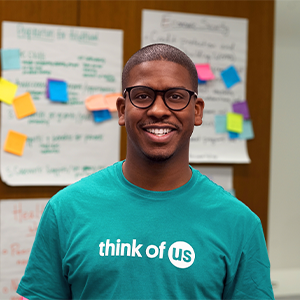
Sixto Cancel entered foster care as an 11-month-old when his mother, who struggled with drug abuse and mental illness, could no longer care for him. They were reunited 5 years later, but when the threat of separation loomed again, Cancel remembers being hidden in a neighbor’s kitchen cabinet as police cars lined up outside. [Video | Transcript]
Officers finally gave his mother a choice. “Either you go to rehab and you sign your children over to the foster care system or you’re going to jail.” That dramatic scene and many others fueled Cancel’s determination to one day help other vulnerable children and families avoid the trauma of separation.
Today, 31-year-old Cancel is CEO and founder of Think of Us, an organization working to transform the nation’s child welfare system and improve outcomes for the millions of children and families it impacts each year. During National Foster Care Month 2023, Cancel told Future of the American Child Cleveland fellows about his organization’s strategic plans for disrupting the bureaucracy of child welfare, and his vision for a system that focuses on strengthening, not separating families.
5 takeaways:
➀ Few people really listen to youth in the foster care system.
Young people who wind up in America’s foster care system have many people making decisions about their future, Cancel said. “A social worker, a supervisor, a judge, a probation officer, a therapist, a psychiatrist, the foster parent, maybe there’s two foster parents, maybe one. I can go on and on about all the voices where decisions that usually were between one or two people are now in a bureaucratic flow of up to 17 folks.”
Cancel said he began documenting the abuse and inequities of his foster care placements when he was 13 years old. “While the other kids got to go to private school, I was told because I was Black, I had to go to public school. While they had rooms, I slept in the attic. And then finally at 13 is when I started to realize the abuse wasn’t normal. The things that were happening weren’t normal.’
Watching “Law and Order” episodes made Cancel realize he had to provide proof of what was happening. “I had to collect data. And so I started journaling. I started to be able to record some of the abuse. And eventually, sometimes the recordings would be caught, sometimes I would lose all the things. But eventually, I was able to get enough evidence that I ended up back in the system and before a judge.”
But because Connecticut is a two-party consent state, all of Cancel’s evidence was inadmissible in court. “When I came back into foster care, I was 15 years old and I really thought that was the end of the storm, but it was the beginning of the next storm. And that next storm was preparing to age out.”
➁ Too many foster care youth leave the system with no training or support.
When he was about to turn 18, Cancel had long since stopped hoping to land in a nurturing home. But he did grasp the need to get ready for adulthood. “So I leaned into being able to be prepared with the financial literacy classes, the asset trainings around buying a car, having an apartment. And by the time I graduated high school, I had those things.”
Cancel also joined the Jim Casey Youth Opportunities Initiative at the Department of Children and Families. “In that youth board, I got to really think about how do you improve a system. And at that time, I was really focused on the process of improvement. So where could you make things better in a system?”
➂ Early brainwaves planted seeds for Think of Us.
Many youth who age out of foster care may have goals, but they lack funding to pursue them. “So my teenager brain was like, “The answer must be SAT prep. That is the barrier to get into college, so let’s work on that thing.” When Cancel was told he wouldn’t be able to get funding, he persuaded teachers at his high school to volunteer as coaches. Then he convinced state legislators that funding SAT prep cost less than foster care.
“We ended up actually funding all of the teachers who were acting as tutors for that program year-round. And then ended up being able to be picked up by one of the foundations, the Annie E. Casey Foundation. And that’s where I just learned so much, how are multiple programs implemented across different states? The power of being bipartisan, operating in red and blue states, how the system is financed.”
➃ Think of Us landed significant new funding through the Audacious Project.
One in three children in the US will be part of a child welfare investigation by age 18, according to a November 2022 Human Rights Watch Report. That’s not only unacceptable, Cancel said, it’s not sustainable. The systems for tracking and coordinating cases are outdated and overwhelmed, and communication between agencies and service providers is haphazard at best.
As one of 10 organizations to receive funding through TED’s Audacious Project, Cancel said Think of Us is strategically positioned to create innovations that can transform the child welfare system. “Audacious is a very unique opportunity where you get to submit some of your craziest ideas and say, ‘What is something very audacious out of the box, which seems impossible?’ We were able to raise in that process over $50 million, and that will be used over the next five years for us to really lean into how do we accelerate some of the change that’s happening right now in child welfare?”
➄ You’re never too old to innovate.
Cancel spent most of his time after aging out collecting stories, listening to other foster care youth, and advocating on their behalf. But a curious thing happened as the years went by. “Everybody was kind of losing their mind because you turn 30 and then all of a sudden your whole life is upended because you’re too old to be on the panels. You’re too old for the foundations to fly you out.”
So Cancel pivoted yet again. He was convinced that lived experience mattered and that he could make an impact. “Once I realized I need to have a true contribution, I realized I need to get the other skill sets. And so that’s when I leaned into technology, I leaned into data, how to build software? How do you think about systems change? And really understanding those very concrete things, how things are financed, how rules and policies are dictating a young person’s life.”
This fellowship is funded by the David and Lucile Packard Foundation, the W.K. Kellogg Foundation and the Heising-Simons Foundation. NPF is solely responsible for programming and content.


 Reload document
 Open in new tab