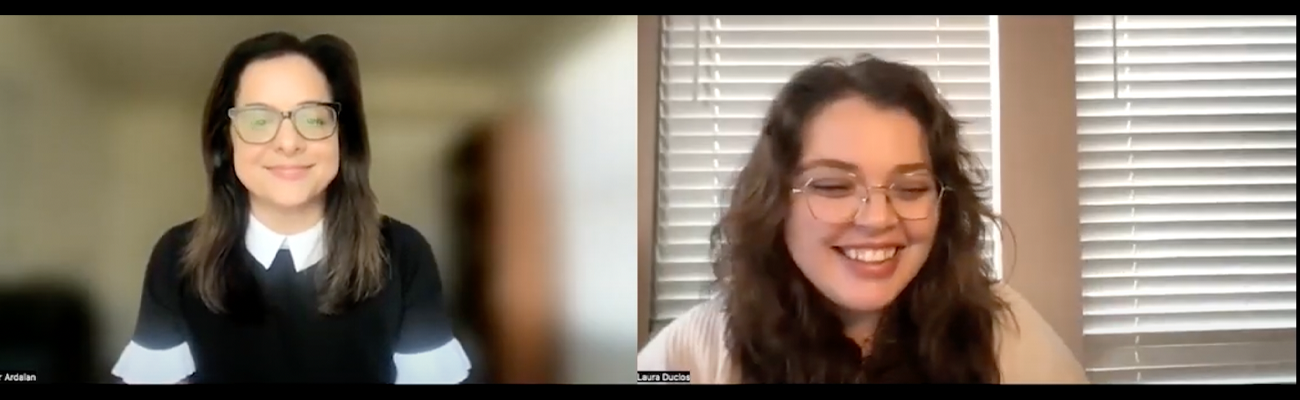
One of Davar Ardalan’s ancestors was the poet Mah Sharaf Khanoum Mastoureh Ardalan, considered to have been the first Iranian female historian. Her mother, Laleh Bakhtiar, was a renowned Iranian-American Islamic and Sufi scholar, author, and translator. It’s no wonder, then, that Ardalan is inspired by the sound of voices. Her work collecting the stories of women poets, artists, leaders and everyday people is expanding the artificial intelligence space and signaling a new era in cultural connection and social justice. Ahead of the launch of the Freedom Speaks voice AI project, Ardalan spoke with Widening the Pipeline fellows about her work in this realm. [Transcript | Video]
5 takeaways:
➀ If Siri can order up a burger, why not a centuries-old poem? In 2019, Ardalan and her collaborators traveled to Geneva at the AI For Good Summit where they presented their concept for Sina the storyteller. Sina was a voice AI tool transmitted through Google Assistant and designed to contain all types of historical and modern-day cultural information. Imagine, Ardalan said, being able to sit on your living room couch and ask Google to “wake up Sina the storyteller” and begin a journey into the past.
➁ Ancestors can live forever through AI. At the height of the COVID pandemic, in October 2020, Ardalan’s mother Laleh Bakthiar died from a rare blood disease. Quarantines made it difficult for her extended family to be with her during her final days. Bakhtiar was a formidable Islamic scholar, and she was the first American woman to produce a gender-neutral translation of the Quran into English. As an icon in Sufism and the Islamic scholarly realm, Bakhtiar had written over a hundred books and collected more than 5,000 letters from family members.
Before Bakhtiar’s passing, Ardalan had been working to translate her work into Conversational AI. “I felt that a new generation of American Muslims should be able to understand from a progressive woman about the tradition of Islam,” she said. Together with her siblings, Ardalan created a demo platform called “Laleh Knowledge Lake, aka “Augmented Wisdom: An Algorithm for my Ancestor.”
➂ “Connection to a broader community through AI? Yes, Please.” Ardalan believes Conversational AI can be a resource for anyone seeking to understand global cultures. “Instead of the weather, you can ask (Alexa) to tell you about a Hispanic heritage culture that is happening in that particular week or day or month, or any other cultural reference that you think is important. It’s also important because you can add culturally rich data that it can curate into compelling and interactive voice experiences.”
Ardalan thinks voice is an excellent medium to support the elderly who are alone, and the visually impaired. Voice also solves distance barriers. “During COVID, many of us were isolated from one another, and here’s a remarkable way to be able to share our stories and cultures with each other and with our younger generation as they grow up.”
➃ Now more than ever, women are using tech to fight for their rights. Last September’s death of 22-year-old Mahsa Amini while in the custody of Iran’s “modesty police” sparked a tremendous outcry from activists and women protesting strict religious rules and dress codes. “These demonstrations were incredibly surprising to many around the world because some of them were young teenage girls who had come out in the streets to talk about wanting their voice to be heard,” Ardalan said. She and her colleagues invited poets and writers to come to a November event in DC to read poetry from Iranian women.
Those readings and other historic poems and dialogues were gathered to create the newly launched Freedom Speaks platform. “This is the power of women in the voice and artificial intelligence space. We’re all over the world. We talk to each other on Slack. We’re creating this tool…virtually, together.
➄ Voice AI can obliterate stereotypes. Ardalan recalled a trip to Tonga for an Australian Aid Society project. It focused on emerging storytelling tools and using virtual reality to help kids in the South Pacific learn about their heritage. “Obesity is so high because they have lost the knowledge of hunting and their traditions of fishing and their traditions of eating healthy food from the land.” As Ardalan and her colleagues used virtual reality to illuminate their history, one 13-year-old asked his father, “Why is it, Dad, that every time I search Google for Tonga, the only thing I see is that we’re obese, we’re fat?”
For communities who feel unseen, unheard, hidden, voice AI can help them claim their glorious creativity, Ardalan said. “It doesn’t have to be viral. It just has to be something that you are proud of that represents your culture, your work, the stories that you feel are not being told that communities need to hear.”
The Widening the Pipeline Fellowship is sponsored by the Evelyn Y. Davis Foundation, Bayer, J&J, Twitter and Lenovo. NPF is solely responsible for the content.



 Reload document
 Open in new tab