Voting Rights Lab’s Amanda Zarrow: How to Track Election Legislation
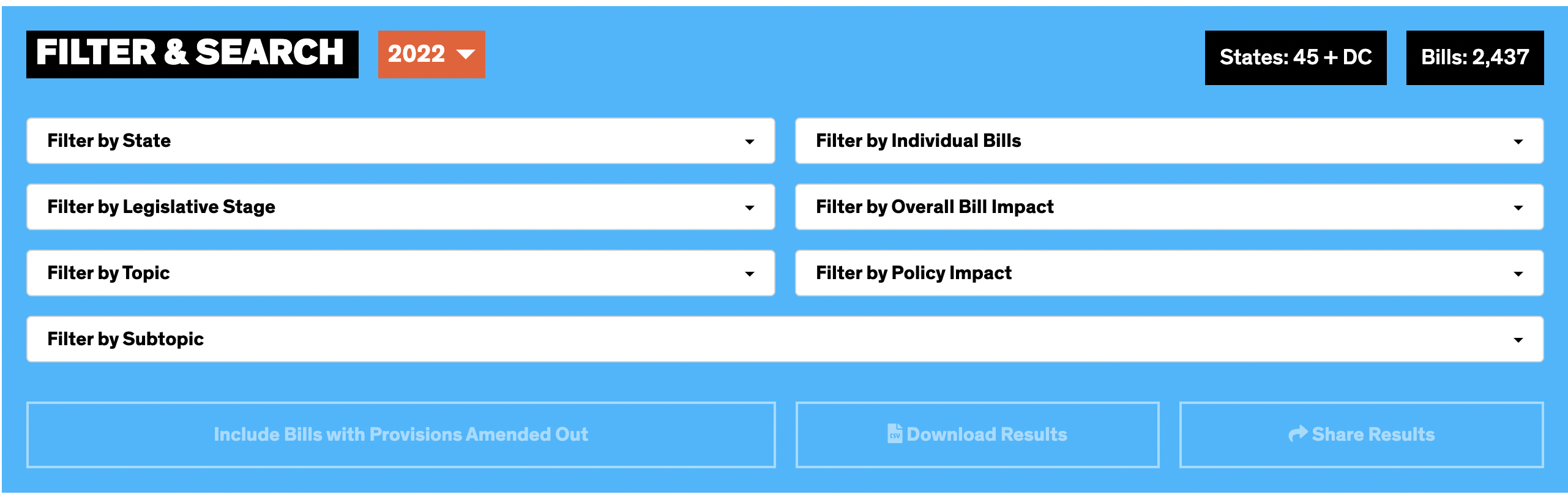
State politics reporters need to know about election-related legislation in their own states and be able to compare them nationally. The State Voting Rights Tracker enables journalists to review pending and current legislation in 50 states and Washington, D.C., said Amanda Zarrow, director of the legal and legislative tracking with the Voting Rights Lab, a non-partisan organization supporting fair elections.
The tracker categorizes thousands of elections-related bills nationwide and is updated daily by a team of lawyers. It can be searched by state, bill number or topic, such as “interference with election administration” or even more specifically, interference with certification of results. The bill entries include the author of the bill, a link to the current text of the bill, the latest action on it and the Voting Rights Lab’s analysis of the bill, including how it differs from existing law.
It also provides a legislative snapshot of what’s happening nationwide.
“Most of the issues that we track in the bill tracker, we also have surveys of existing law for … so that can be a helpful resource when you’re trying to figure out, ‘OK, what is the background rule in the state and how long has it been that way?’”
In 2022, Zarrow said, there are about 250 bills that, “if enacted would really run the risk of interfering with election administration.” About 70 would impose “partisan or burdensome election reviews that really differ in kind from your traditional statistical or risk-limiting election audit,” 56 penalize election administrators, some even for “good faith job performance,” and 43 “are legislature power grabs, plain and simple.”
Zarrow said they’ve been most surprised by the “emerging trend of targeting election administrators themselves … I don’t think we saw that coming at all, frankly. And it’s been something that we’ve really dug in deep on because it’s about the way our elections operate, it’s about how our ballots are counted, our elections are certified. It’s about how our elections are funded, really critical stuff that I think is very behind the scenes.”
Texas Tribune’s Alexa Ura: Make Voters Central to Your Stories
While the news may come out of statehouse, “at the end of the day, you are talking about real people who might be disenfranchised because of the actions that you are covering, so this is my plea to you all to remember to center your voters,” demographics reporter Alexa Ura said.
She pointed to a story she did in which she took a proposed formula for regulating polling places and mapped it out, thus showing that there would be fewer polling places in areas with higher concentrations of voters of color. “It doesn’t just have to be, this is what Republicans say, this is what Democrats say. It can be, here’s what this proposal is and here’s how it could actually affect voters in these communities.”
Ura also reminded reporters to use clear, exact language — not jargon or party lines.
Privileged readers may not understand voting restrictions without these human stories. “If you are a voter with a car, with a schedule that allows you to go vote at any point … if you are someone who really doesn’t have to worry about being able to exercise this right, you might not accept other people’s realities,” Ura said.
This was echoed by Anthony Gutierrez, executive director of Common Cause Texas, using the example of voter ID laws. “Here’s a person that’s going to be impacted, not because they don’t have the identification, but because you wrote a law that’s just really damn confusing and people are going to be worried about like, ‘Well, I’m not sure I have one, so I’m just not going to go because it seems like a hassle.’ Finding those human stories … is the single most important thing you can do.”
Common Cause’s Anthony Gutierrez: Go Deeper, Follow Through
Gutierrez said a pet peeve of advocates is when a flood of reporting turns into a trickle and the actual impact of a bill is missed.
“Whenever a bill gets filed … there’s the first round of stories that are like, ‘Here’s what this thing is. This is why it’s bad,’” he said. “We don’t see enough of the next step, really deep-dive coverage.”
He cited the need for continuing reporting on Texas’ rejection of mailed ballots, how citizens’ fought it, and the Secretary of State’s role. The “‘why did that happen’ stories are the ones I think we don’t see,” he said.
Gutierrez also talked about the need for journalists to connect the dots between political moves and their effects.
“In Texas, if we had a decade of these maps that were in court and by our accounts completely gerrymandered and illegal, well, what were the policy implications of that? What were the things that happened in that decade that wouldn’t have happened if we had a fair map at the beginning of the decade? … obviously, this is how it’s going to impact voting, but what’s the impact beyond that? How is that going to affect how public policy is created in the next legislative session if this political party is able to manipulate the outcome of the election to take the majority?”
The Statehouse Reporting Fellowship was sponsored by Arnold Ventures. The National Press Foundation is solely responsible for the content.




 Reload document
 Open in new tab