5 takeaways:
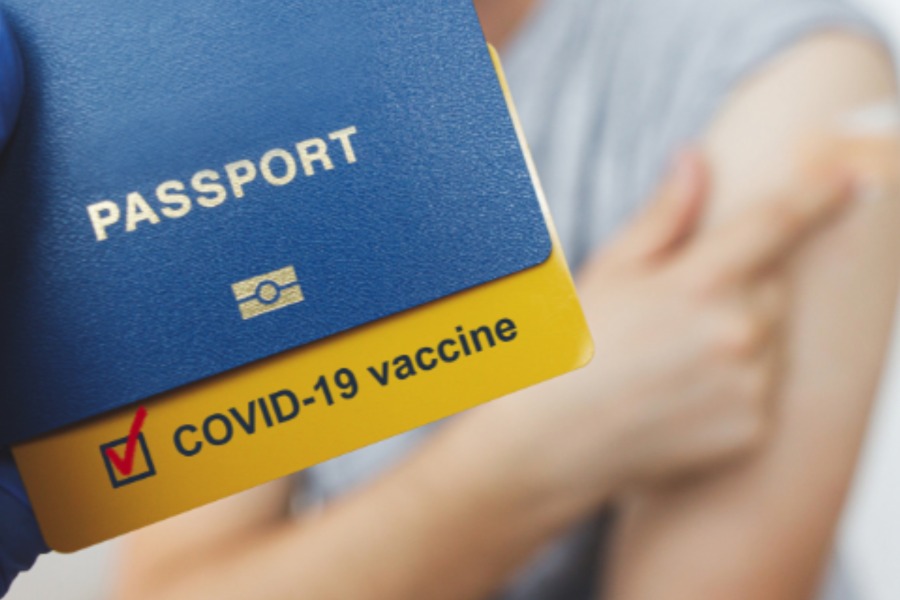
➀ Vaccine passports are “a terrible bit of terminology.” The Cato Institute’s Julian Sanchez says backlash is building against requirements for government-issued documents that verify vaccination status for purposes other than crossing international borders, such as entering stadiums, museums or other public places. France’s newly-approved COVID green pass faced harsh scrutiny after thousands took to the streets to protest the measure. A more neutral term journalist should consider is “immunization credentials,” Sanchez said. U.S. District Judge Damon R. Leichty, an appointee by former President Donald Trump, recently ruled that Indiana University may require students to submit proof of their COVID-19 vaccination status prior to returning to campus this fall.
However, SMU Dedman School of Law’s Seema Mohapatra warns that vaccine passports are likely to give a false sense of security in the absence of universal masking and other infection-control measures. The Centers for Disease Control and Prevention paper vaccine certificate given to those vaccinated in the U.S. is trivially easy to forge and a digital alternative is preferable to carrying around “a flimsy deteriorating card with you all the time,” Sanchez said., U.S. District Judge Damon R. Leichty, an appointee by former President Donald Trump, recently ruled that Indiana University may require students to submit proof of their COVID-19 vaccination status prior to returning to campus this fall.
➁ Despite privacy concerns, some want “a universal highway” for verifying vaccination status. Glenn Cohen of Harvard Law School said the White House should lead the charge on introducing a federal digital credential system to prove vaccination status. “I wish [President] Joe Biden would build a highway even if he doesn’t plan to enforce or set the rules of the road,” Cohen said. Should the federal government fail to implement a protocol for vaccine credential verification, Cohen expects to see states and private companies do so, leading to the fragmentation of data and new concerns over potential privacy breaches. A unified national system is safer than a patchwork, others agreed.
➂ But vaccine passports would widen the digital divide. Inability to get vaccines – because of lack of access, lack of immigration documentation, health problems or nationality – would further exacerbate the digital divide in America, argued Seema Mohapatra, a visiting professor of law at SMU Dedman School of Law. Apps like New York’s Excelsior Pass only work for people who have access to smart phones and broadband and will exclude vulnerable populations who have suffered most from the pandemic, she warned. They could also exacerbate racial injustice when it comes to “who is being policed and who is being asked for their proof,” she said.
➃ Proof of immunization records are not new. At the turn of the last century, employers had a “show the scar” requirement for employees to prove they had had their smallpox vaccinations, Cohen said. Some countries have also required proof of yellow fever vaccination for entry. However, the experts cautioned journalists against conflating mandates of proof of vaccination with requirements that citizens get vaccinated. Cohen said the incidence of breakthrough infections is a strong argument for immunization credential systems that would help track outbreaks, including among the vaccinated. “There’s actually a strong argument for collecting this and the United States is really, and this is true about all vaccination, incredibly behind the rest of the world,” Cohen added.
➄ Prepare to cover a debate over the issue of data permanence and record retention. Agencies should store vaccination data only for as long as the vaccine protects patients, then delete it as soon as the vaccine effectiveness ends, Cohen said. Agencies should consider instituting automatic deletion. Sanchez said that the government not collecting the data displayed by a digital app or registry is even better than automatic deletion, offering an “olive branch” to those who are concerned about privacy.
Speakers:
Glenn Cohen, James A. Attwood and Leslie Williams Professor of Law, Deputy Dean, Faculty Director, Petrie-Flom Center for Health Law Policy, Biotechnology & Bioethics, Harvard Law School
Seema Mohapatra, Murray Visiting Professor of Law, SMU Dedman School of Law
Julian Sanchez, Senior Fellow, Cato Institute
Dawn Kissi, Co-Founder, Emerging Market Media, Board Member, Association of Foreign Press Correspondents in the U.S.A. (moderator)
This program was funded by Bayer. NPF and The Association of Foreign Press Correspondents in the U.S. are solely responsible for the content.