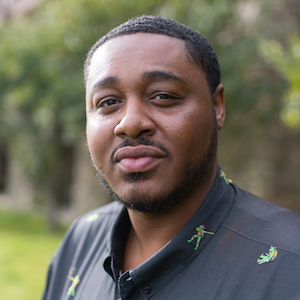
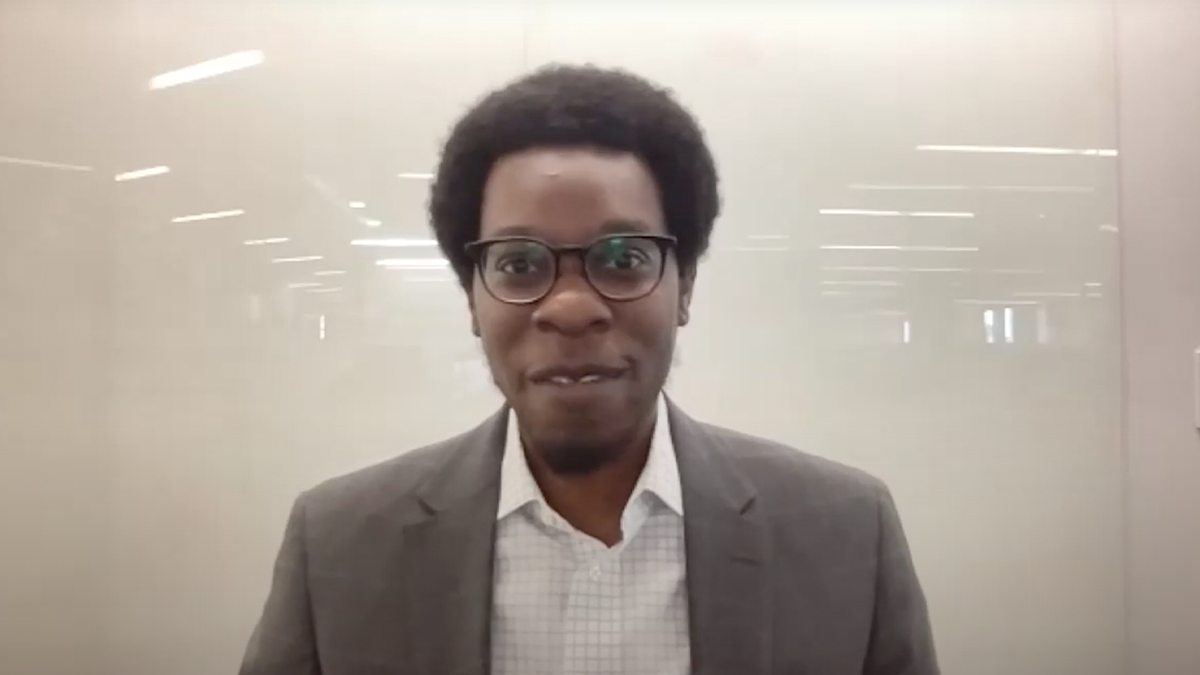
Ty Rushing knows what it’s like to stand apart from the crowd. Working as a political correspondent in rural Iowa, he is often the only Black person in the room.
In April, Rushing told Widening the Pipeline fellows that started his career as a journalist at the Newton Daily News, a small-town newspaper headquartered several miles east of Des Moines. It was his first job out of college, and he was eager for any work in the journalism industry. He had already dealt with rejections, and he suspected race may have played a role.
“My full name is Tyren, but I go by Ty because when I was applying for jobs, they didn’t really like those Black-sounding names. I couldn’t even get an internship. So once I started going by Ty professionally, that opened up a lot more doors for me.”
Rushing has worked for a variety of news organizations, and he’s been the first Black reporter at eight of them. He started out covering local politics and news before eventually going national. As Rushing puts it, almost every reporter in Iowa becomes a national political reporter at one point or another, particularly when the caucus comes around.
Rushing said that he isn’t the kind of person who can blend into the background at political meetings. He is used to showing up in places where there are not many people who look like him.
“I can’t be the fly on the wall. I’m going to go in somewhere and all heads are automatically turning into me and I’m just going to look right back at you, hit you a little smile and go do my thing,” Rushing said. “And so I’ve tried not to let that being the only person who looks like me being in these rooms intimidate me or dissuade me or prevent me from doing my job. You just got to go through, power through, act like you belong.”
In August of 2023, Rushing made headlines himself while covering Florida Governor Ron DeSantis’ Iowa caucus campaign. At one point, noticed one of DeSantis’ security guards taking pictures of him and his coworker during DeSantis’ appearance at the Iowa State Fair. Rushing found this strange, but he ignored the guard and continued to do his job.
When Rushing showed up at the next DeSantis event, he saw police cars surrounding the entrance. He said at the time he was thinking, “‘I know they ain’t for us. I know they’re not here for us.’ And I just start laughing to myself because I’m like, ‘This would happen to me.’”
The officers told Rushing, “It was a private event, and they don’t want you,” and it “didn’t matter” that Rushing and his coworker were registered for the event. Rushing posted a video of the conversation on X, formerly known as Twitter. The incident drew national attention.
“I know in my head, I see law enforcement officials with guns and my big Black ass in rural Iowa. I need to stay calm. I can’t get angry. I can’t get mad. I got to be chill. My coworker who joined me was a white guy, so he was pushing buttons. I was not.”
Overall, Rushing emphasized the importance of ignoring the people who harass him because of his race.
“You got to ignore the haters because they’re always going to be there. I got called a Black agitator who was educated in the Kansas City public school system for writing about race and racism and my experiences with it. And so one of my editors was like, The Black Agitator, that’s your superhero name.’”
Access the full transcript here.
The Widening the Pipeline Fellowship is sponsored by the Evelyn Y. Davis Foundation and Lenovo. NPF is solely responsible for the content.