5 takeaways:
➀ The U.S. government’s decision to limit DJI sales is part of an accelerating global trend toward “techno-nationalism.” In December 2020, the U.S. Department of Commerce put China’s Da-Jiang Innovations on its “entity list,” banning U.S. firms from exporting technology to the company unless the exporter receives a government license. That case is still playing out and the Biden administration has not yet announced its position. Alex Capri of the National University of Singapore Business School and the Hinrich Foundation said it’s the latest example of “techno-nationalism,” in which countries attempt to advance their power by investing in advanced technologies and keeping it out of the hands of foreign military and civilian competitors. Companies such as Huawei, TikTok or WeChat are caught in the middle because their products have dual uses – both commercial and military applications – or can be used for surveillance or to commit human rights violations, or because the data they collect might threaten national security. (For more about the weaponization of U.S. data, see this NPF program; another Capri briefing to journalists is here.)
➁ Reporters need to be skeptical of the national security rationale offered for action against foreign companies. Trump administration decisions are running into roadblocks in the courts, noted Anupam Chander, a professor at Georgetown Law. Federal judges have ruled against the U.S. government in cases including the ban on the social media app TikTok. “I think reporters – in particular, American reporters – were not as skeptical of the Trump administration’s national security rationale as they should have been,” Chander said.
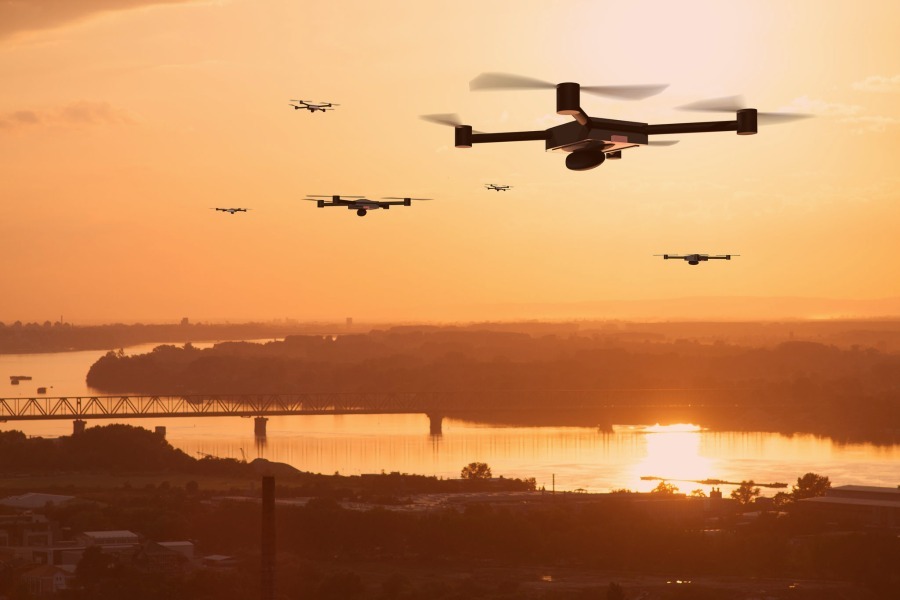
➂ Drone sales are skyrocketing and becoming an important trade issue. Capri estimated that the drone market will grow nearly 70% between 2019 and 2025. China’s Da-Jiang Innovations controls 72% of that market because it makes – in the eyes of Capri, a drone enthusiast – “absolutely brilliant, brilliant products.” “I absolutely love DJI,” Capri said. “The pictures are stable, sharp. The technology is affordable.” It is being used both by Chinese authorities and by U.S. law enforcement.
➃ COVID has accelerated strategic decoupling in the tech sector. Capri said techno-nationalist impulses have led to fragmentation in supply chains and re-shoring of strategic industries so firms aren’t too dependent on one country – typically China. This was underway before the Trump trade wars and before the pandemic. “The Chinese are absolutely doubling down on de-Americanizing their technology supply chains,” Capri said.
➄ China has fired back at the Trump administration’s actions with its own list, but the endgame is uncertain. In January 2021, China responded with new rules to punish companies that comply with Washington’s restrictions. Henry Gao, an associate professor of law at Singapore Management University, said the “blocking statute” was intended to counter foreign laws that restricted companies in China from engaging in normal business practices. “What China is basically doing is … trying to watch and see, to see what the new administration of the U.S. will be doing and then try to react accordingly,” Gao said.
This program is funded by the Hinrich Foundation. NPF is solely responsible for the content.