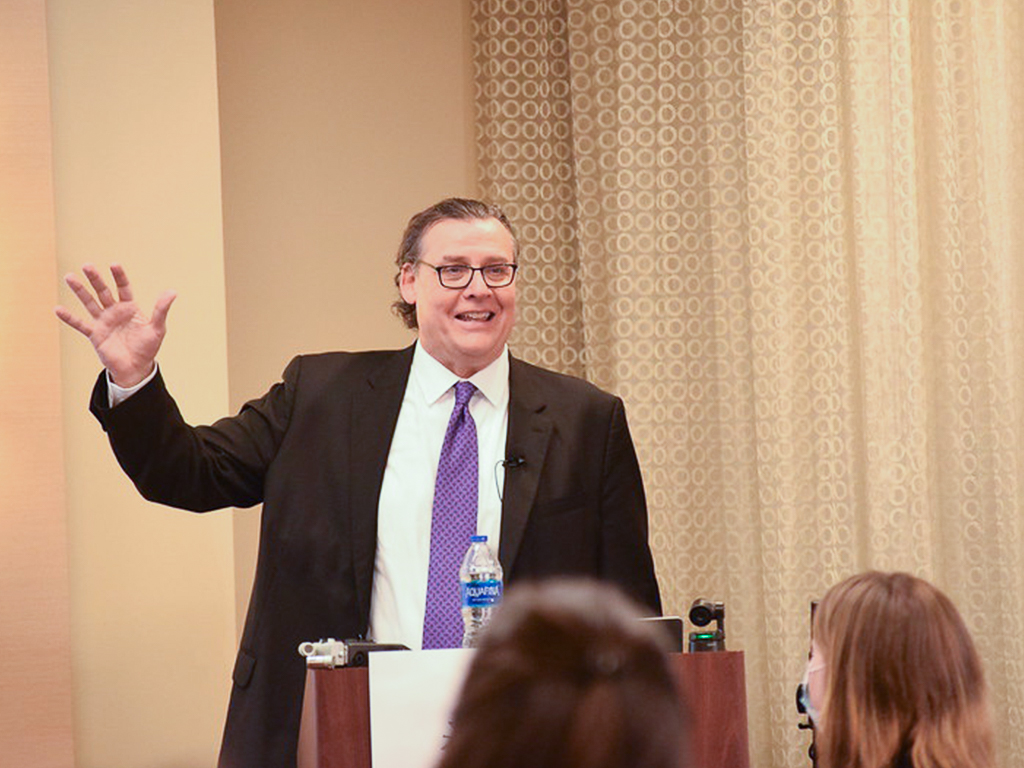
1. Social media allows candidates to dump the mainstream media. Many Texas Republicans feel they no longer need the media now that they can get their message out directly through email and social media, Matt Mackowiak, president of Potomac Strategy Group in Austin, Texas, told NPF’s Statehouse Reporting Fellows. “They feel like the media is on the other team and engaging with the media, generally, in Texas is net unhelpful,” he said.” Transcript | Video
He also said newspaper endorsements have “never mattered less than they do today.”
“There’s some concern they might actually hurt, that it makes our base voters wonder if you’re really conservative if the big bad media is endorsing you,” Mackowiak said. “If you’re a Twitter-elected official on either side of the aisle, ed boards are not helpful because what they’re going to do is they’re going to basically reveal how shallow your knowledge is, how shallow your accomplishment record is. And generally, ed boards have intelligent people asking thoughtful, serious, dry questions; and some elected officials can handle that, a lot of them can’t.”
Using social media to reach voters means that politicians are preaching to the choir, Mackowiak said, but with voters and the media becoming more “tribalized” that may not be seen as a downside. “The bigger point is we have people in our country on both sides who just want to receive information they agree with, and the unfortunate thing about that is they’re not learning anything.”
2. Data on voter motivation drives most Republican strategy. “Any campaign that is being run professionally is basing their decisions on data. … You can have instincts, you can have intuition, you can have ideology … but in the end, the candidates that do the best on both sides of the aisle are the ones that are talking about the issues that voters care about,” said Matt Mackowiak, president of Potomac Strategy Group in Austin, Texas. “Candidates are not going to change the issues voters care about. Voters care about issues based on what affects their lives, number one, and number two, what’s in the news … and social media has affected that.”
For more on uncovering what voters care about, see NPF’s “How to Spot a Bad Poll.”
3. Reporters may be punished if trust is broken, Mackowiak said. “Sourcing is a two-way trust relationship … if the trust is violated, the person that violates it needs to pay some kind of penalty for that,” said Mackowiak, who worked as a press secretary for two U.S. senators as well as in the George W. Bush administration at the White House and the Department of Homeland Security. “If you’re being mistreated by a news organization, you can de-emphasize working with that news organization and work with news organizations that you think are more fair.”
He said the best D.C. reporters called him even when they didn’t need anything, just to see what was going on that week. This can lead to story ideas as well as establish that relationship. (White House reporters agreed when talking to Paul Miller fellows this year.) Just because a politician won’t answer you doesn’t mean your reporting is over, Mackowiak said. “Go in and around their orbit and get comment and feedback and analysis from people that know more, who may not be limited by whatever limitations that office or that official is putting in place. Former campaign managers, PAC donors to that person, people who served in executive offices, former chief of staff, former spokesperson. If you can’t get to the governor, go to the state party.”
4. The news media look like “stenographers for the Dems” but “critics for Republicans,” Mackowiak said.
“Part of how I think we restore trust in journalism is really by just presenting truly independent information that is verified,” Mackowiak said. Don’t “make it more complicated than it needs to be. Who, what, where, when, why and how… just get to the basics. It doesn’t need to be flowery language, deep analysis, and all kinds of different angles.”
When advising candidates about which journalists to talk to, he thinks about who’s going to cover the race the most, who’s covering the issues they care about, and who he can trust to give a “fair shake.”
“If you’re doing a story that has negative consequences on a target … have they been given enough time to respond? Is there a context here that’s not being provided?” he asked. “Sometimes reporters can be used. I think we all understand that. Someone drops oppo on you, maybe they’re clever how they get it to you. You have to ask yourself, are you being used by someone? Who are you being used by? Who benefits from this story coming out, and is there something about that needs to be explained or provided?”
“The laziest thing in journalism is ‘experts say,’” he said. “I don’t care what experts say, I care what one expert says. Who is he, or she? Who do they work for? Who funds them? Sometimes we leave that piece out.”
If a reporter who wants an interview demonstrates “seriousness and substance and knowledge about what they’re doing [it] will always set you apart,” he said.
You may also be interested in: ‘Racists’ vs. ‘Socialists’: Partisan Likely to Endure, Charlie Cook predicts
The Statehouse Reporting Fellowship is sponsored by Arnold Ventures. NPF is solely responsible for the content.