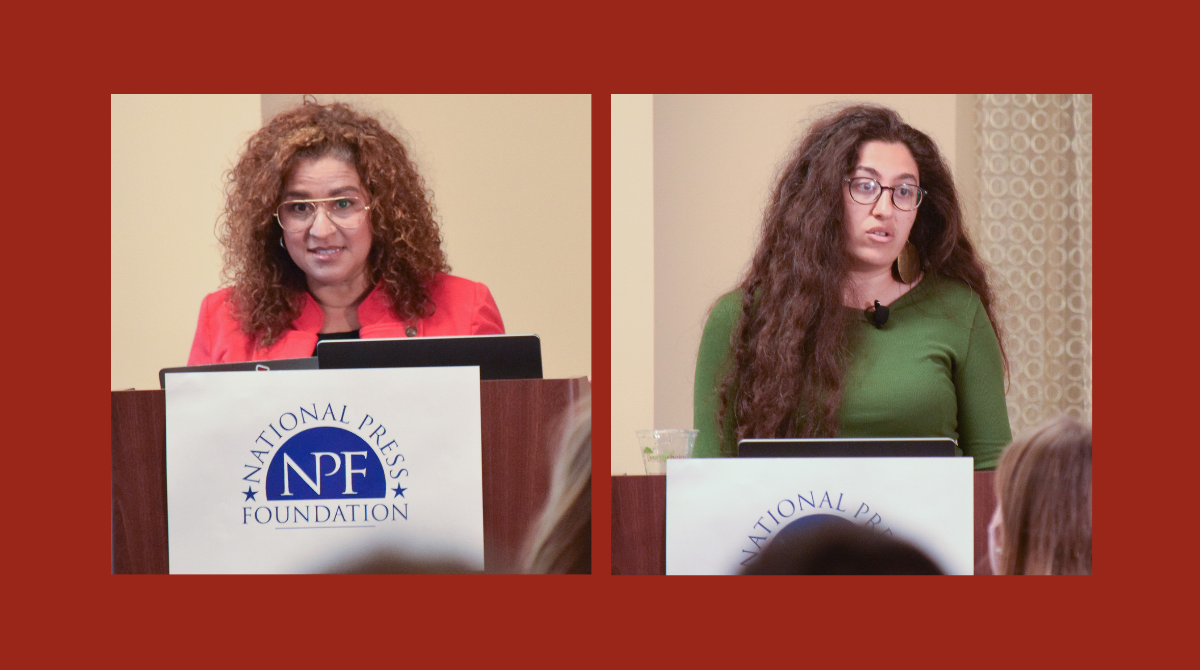
With low trust in the news media, the government and other institutions, it can be difficult to encourage Americans to engage with factual information. In a session with NPF’s Paul Miller fellows, Mónica Guzmán of Braver Angels, a nonprofit combating polarization, suggests prioritizing curiosity on how people reached their beliefs. [Transcript | Video]
5 takeaways:
➀ Journalism is about building bridges. “Journalism is this practice of having lots of conversations that are about understanding without judgment,” said Guzmán, author of “I Never Thought of It That Way.” The work of reporting is showing how sources came to the conclusions that they did. “Something about telling their story responsibly is going to make our community stronger,” she said. Guzmán said these judgment-free conversations became much rarer during and since the 2016 election.
When working as the vice chair of the Society of Professional Journalists’ ethics board, Guzmán prioritized minimizing harm and building trust with sources. “Asking how they came to believe what they believe, asking for their stories, these are the sorts of questions that ask people to give you their meaning.”
➁ Prioritize curiosity. “People think of curiosity sometimes as being sort of intellectually selfish,” Guzmán said, but thinking of curiosity as “a form of care” can show sources their viewpoints are worth listening to. “If listening is about showing people they matter, then the way you show people they matter is by aiming your curiosity at them.”
Guzmán’s organization, Braver Angels, holds monthly debates to help its members understand why the other side has the opinion that it does. “My work rests pretty solidly on the premise that we don’t have to wait for politicians to figure this out and we don’t have to wait even for us journalists or media institutions to figure this out, that every conversation can be one level more curious.”
➂ Tell stories about people, not labels. “The research is also showing that people are so scared to share their honest opinions about politics to each other, let alone to you, to journalists,” she said. The automatic assumption can often be to ask sources why they hold their opinions. “But at a time of polarization and deep division and distrust and suspicion, asking why can make people feel like you want them to justify themselves, like they have to prove that they matter before you’re willing to believe that they matter,” Guzmán explained. Asking how people reached their beliefs, instead of why can encourage them to reflect. “You ask them to take you on a tour instead of putting them on a trial, and they get to step back and look into their own story instead of the talking points, instead of the narratives that we’re all so beholden to.”
➃ Online political discussions don’t suffice. “We do a lot of discussion on platforms that boil down the full power of conversation to some words and some emojis,” Guzmán said. Prioritizing an equal level of power in online conversations can help create “candid” exchanges. “If someone posts on Facebook and someone else comments on Facebook, the one with the power is the person who’s posting,” she said. “They can hide or block or delete your comment.” Online conversations can also serve as “proxy battles” between sides. “A lot of our discussions happen in places where we’re discussing in front of an unknown audience of potentially mass size, so what people end up doing is they end up performing perspectives instead of exploring perspectives.”
➄ Pay attention to language. Word choice can estrange partisan readers from articles, for instance, using the term “homeless” vs. “unhoused.” Even words like “democracy” have been called out by conservatives, she said. Guzmán recommends asking sources to describe things in their own terms. Journalists must then think critically about which words fairly and honestly characterize the topic. Braver Angels has used slashes to separate terms that could be construed as partisan, such as a conversation on “voter rights/voter security.”
NPF is solely responsible for the content.