NPR’s “Planet Money” host Robert Smith says the evolution of the American economy requires every journalist to master the art of following the money.
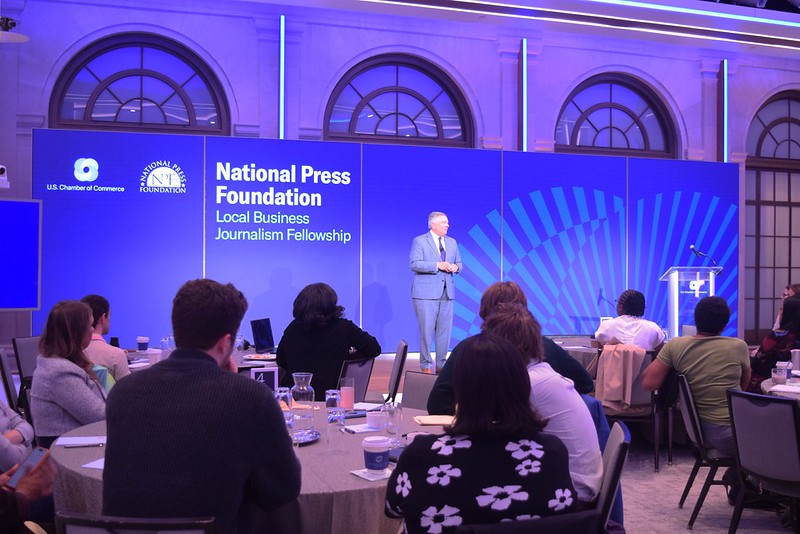
“It’s amazing when you look at it, the breadth of what we cover now, and more than that, let’s be honest, every story is now an economic story,” Smith told NPF Local Business Journalism fellows. It is the number one story every day. And if you don’t understand money and don’t understand the way money works, then you’re behind in politics, in the arts, in media, whatever you follow.”
Smith, who also directs Columbia University’s Knight-Bagehot Fellowship in Economics and Business Journalism, said the key to effective business journalism is to make complex financial systems relatable through genuine curiosity and human-centered narratives.
He provided examples from his show, such as explaining the housing crisis through a plain-speaking subprime borrower named Clarence. During the 2008 financial crisis highlighted by the collapse of entities like Lehman Brothers, people like Clarence were buying houses and getting loans they weren’t really qualified for.
“A lot of people had told this story about, well, mortgage securities and bonds and interest rates and all of that. We’re like, but yeah, each of those steps has a person in each of those steps. Somebody sold each of those things, somebody bought each of those things. Who are those people and what were they thinking?”
In a clip from an interview, Clarence explained that he borrowed $540,00 and the bank didn’t check his income. He even confessed that he wouldn’t have loaned the money to himself. “I mean, I know guys who are criminals that wouldn’t lend me that money and they break your kneecap,” Clarence said. “So yeah, I mean, I don’t know why the bank did it.”
That’s the way to drive home the impact of economic policies and financial shifts for American consumers, Smith said. “You got to find your Clarence, you got to find your person who’s going to make this thing real,”
He also briefed journalists on the proper use of financial numbers, stressing the importance of context and understanding what a number truly represents. For example, in an interview with an economist about retail sales and the so-called “K-shaped economy” where “the rich are getting richer and the poor are getting poorer,” Smith invoked the topic of baby clothes.
“I was joking with the economist about, ‘Oh, people want a souvenir onesie or a baby tuxedo.’ I’m constantly trying to give the audience something they can picture because economists will not give that to you. They will not. They want to talk in numbers and big pictures. So he’s talking about the different markets and I’m like, “Oh, like a cheap onesie or a baby tuxedo.” And he laughs and you can picture these two different things.”
So when Smith actually found several retailers who sold baby tuxedos, a story was launched. “And so now this whole piece, people are learning about the economy. They’re learning about the things just like Clarence was teaching you about the forces of homeowners and loans and mortgages. This is teaching you about retail sales, manufacturing, the divergence of the two different economies through baby tuxedos. And when people walk away, that’s the kind of thing they are going to remember.”
Access the full transcript here.
This fellowship is sponsored by the U.S. Chamber of Commerce as a continuation of a journalism training and award program launched in 2025. NPF is solely responsible for the content.