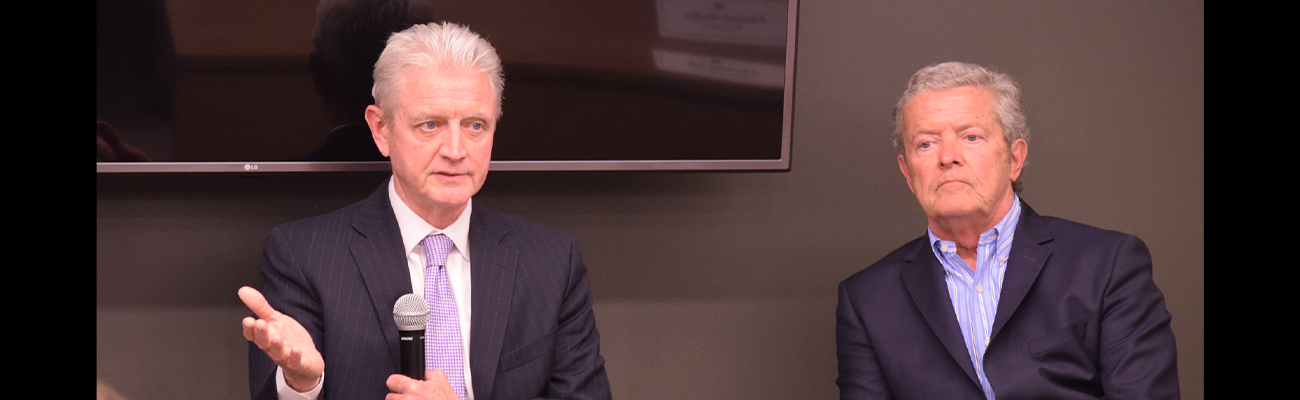
Pentagon correspondents occupy one of the most crucial beats in Washington, but there aren’t enough of them to cover a vast reporting portfolio that ranges beyond combat and weapons systems. Tom Vanden Brook of USA Today and Tom Bowman of NPR have made careers uncovering stories that affect average Americans, and they discussed a shared strategy that helps separate their work from the pack. [Transcript | Video]
5 takeaways:
➀ Go the extra mile.
“If you’ve got a really sensitive story and you’re worried about it and you want to make sure that you’re right and that you’re not going to embarrass yourself or your paper… you talk to people who know what’s going on,” Vanden Brook said. When most information regarding a story is classified or especially sensitive, journalists can use the help of high-level officials to “steer” them in the right direction.
The strategy can provide a crucial check on conclusions drawn from previous reporting. “This has to be somebody at a level who knows what’s going on,” Vanden Brook said. “Preferably you’d want them to be a source for you, but it doesn’t always happen that way.”
➁ Reporters are only as good as their sources.
Bowman said he once spoke with a spy at the Defense Intelligence Agency who suggested that were in the same line of work because they both convinced people to tell them things they shouldn’t albeit for different reasons. Bowman said he initially rejected the suggestion until the spy explained: I do it to get people to betray their countries; you get it to tell people what’s really going on. “Never really thought of it that way, but he’s right. We’re only as good as our sources. You can sit in the White House Briefing Room, I don’t recommend it, you can sit in the Pentagon Briefing Room. Nobody who stands there is going to tell you the truth. No one.”
Consider what briefers don’t say. “You have to get out and see real people…This is not a real city,” Bowman said. “This is a theme park, and you better learn that now.”
During a previous stint at the Baltimore Sun, Bowman said he worked with famed journalists Jack Germond and Jules Witcover, who “were always out there talking to real people, union leaders, political leaders, small-town mayors. They had a better sense of what’s going on than most reporters because they did not stay in Washington.”
With the right sources, journalists can uncover even protected intelligence. “When it comes to the intelligence stuff that we’re talking about, about spying, it’s all knowable, but it’s just the degree of difficulty,” Vanden Brook said.
➂ Ask the hard questions.
“The great thing about being a reporter is to stick it to people,” Bowman said. “Because if you’re not going to ask the hard questions, if you’re not going to hold their feet to the fire, why are we even doing it? Go get a real job.”
One area that often requires scrutiny is funding. A few years ago, the U.S. had between 150,000 and 200,000 troops deployed in other countries. “There aren’t any troops deployed right now,” Vanden Brook said. “So why do they need all of this money?”
➃ Reach out to embassies.
“There are some countries leaning forward on Ukraine much more than this country is,” Bowman said. “Those people like to talk.” Ask embassy officials what they are hearing, Bowman urged, especially from Americans.
When talking with sources who have sensitive information, stay off email. “Get cell phone numbers,” Vanden Brook said. “Email’s great, but they’re not going to respond to email, especially on a military email.” Sources are more likely to feel comfortable dealing with reporters on cell phone or Signal.
➄ Pay attention to China.
“There’s a reason that we’re sending (Taiwan) billions of dollars in arms every year, and China makes no bones about the fact that it wants Taiwan,” Vanden Brook said. “How likely is that? …it could be just a matter of years. That would be incredibly bloody and we’re committed to their defense.”
“China is the outstanding issue; will be for many, many years to come,” Bowman said.
Keep an eye on Russia, too. “They have lost half of all their tanks, a third of all their armored personnel carrier, at least 250,000 casualties,” Bowman said. “What is the future of that military? I think that’s absolutely fascinating. And now with Finland joining NATO, that’s more of a threat.”