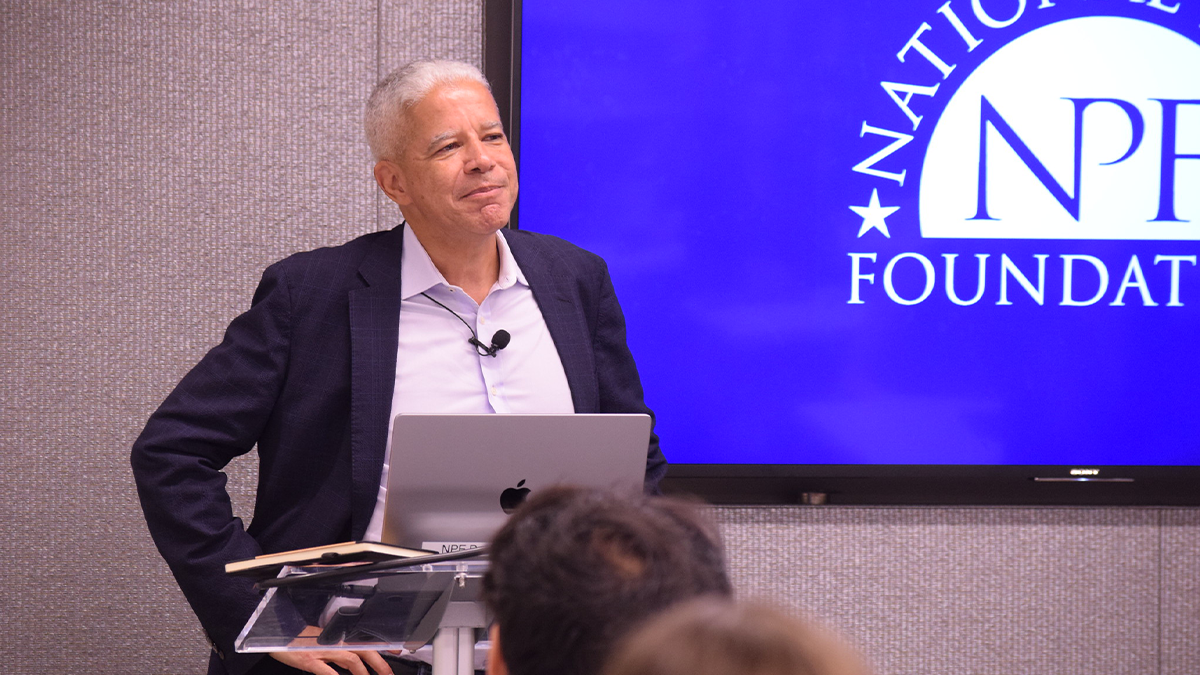
Marc Lacey Transcript — Sept. 5, 2025
Kevin Johnson/NPF (00:00:00):
I’m really excited that Mark is here because anytime I feel discouraged about the state of our industry and there’s plenty to be discouraged about, I often look to what he’s posting on social media. Those posts are a constant source of encouragement, highlighting good work, exuding energy and optimism that are rare in these days of buyouts and budget cuts. But he also has a pretty important day job. As many of you know, mark is the managing editor at the New York Times where he is also served as an assistant managing editor, national editor, weakened editor, deputy foreign Editor, and a correspondent covering Congress, the White House, the State Department, east and Central Africa, Mexico, central America, the Caribbean, and the US Mexico border. I don’t think there’s any place he’s skipped along the way,
Marc Lacey/New York Times (00:01:05):
All those things.
Kevin Johnson/NPF (00:01:07):
He’s done it all. But he also sat where you are today as another Paul Miller alum from the class of 95 96, and we’re trying to figure out where those classes met over the years, but it was too long ago. So we gave up. But I want you to please welcome back and welcome back Mark Lacey.
Marc Lacey/New York Times (00:01:33):
Thank you very much. When I tell people how long I have worked at the New York Times and I speak a lot to the new hires, people who are just coming in or the fellows, we have a year long fellowship and I tell them how long there is inevitably a gasp because they realize that I have been at the New York Times longer than they have been alive. And so it is approaching 26 years at the New York Times. And when I think of someone working at one place for 26 years, I kind of think of it in a sad way, like someone sitting at a desk with a big pile of papers doing the same task and retirement is looming and it’s a really sad tale, but I don’t want you to feel sorry for me because it is not sad. I walk to work every day. It is a 14 minute commute from where I live and I go in a side entrance of the New York Times building and every single day I am excited by what I am going to encounter that day.
(00:03:05):
And I’ve been a journalist for a long time and I really can’t believe that I’m still excited by the work and my job is very different from the previous jobs that I’ve had, but I still find what I’m doing. Fascinating, important, unpredictable, and I still sort of love to go to work every day. This causes a lot of concern with my wife who sort of thinks, why are you so happy to be going to work? And on vacations at the tail end of a vacation, I sort of get into this mode where I start thinking about work again and she can tell when I start thinking about work again, my son just graduated from college, is sort of figuring out what he wants to do and he said, dad, not all of us are like you and are excited by work. And the other day he sent me a very depressing survey that I’m going to share with you.
(00:04:29):
It was a list of the worst professions in America, sort of a ranked list. It was one of these internet surveys and probably the methodology was totally bunk, but he sent it to me with great joy because it listed news reporter as the worst job in America, the very worst. Okay, below news reporter there was there roofer, ditch, digger, janitor, there were all these other jobs that I didn’t want and that you probably don’t want, but they said news reporter was the worst. And so they said a few things and unfortunately a lot of these things that they said were true. So they talked about the large number of how it’s a shrinking industry and they talked about all of the layoffs and the job opportunities or there are fewer job opportunities today than there were years ago. Happens to be true. They talked about the unpredictable hours and related to that was the lack of a healthy work life balance. They talked about that. That happens to be true. I had black hair, not a single gray hair when I started at the New York Times and I blame the New York Times for each one of these. So work-life balance is not why you become a journalist. They talked about the pay and they said that you can make a whole lot more money doing other things with the same education. And that is true.
(00:06:42):
I was on the college paper, that’s how I got into journalism. And if you look at some of my classmates, they became lawyers, they became investment bankers. I was in college when Apple was just growing as a company. It was still a small company growing. So there’s one guy who was one of the early people on Apple and he’s doing very well for himself. So this is not an industry that you go into to, as my son says, make bank. You don’t do that. And if you want to make a lot of money, there are other things that you can do. So that’s sort of the depressing part of what I have to say. And in the q and a portion that I’m looking forward to, we can talk more about the depressing part, but the really uplifting part is that I became a journalist in college as an activity, not as a job.
(00:08:00):
I spent countless hours on the college paper, wasn’t getting paid, was doing it because I wanted to do it. I was doing it because I thought I loved the idea of finding things out before everyone else. I loved the idea of communicating with the rest of the campus. I loved grilling the president of the university. I was a near sophomore and the president looked terrified of me as I’m asking questions. I loved all of that. So I did it as an activity and I did it because I loved it. And that is still true today, 25 going on 26 years at the New York Times. I’ve had a dozen different jobs during that time. Each one has sort of felt like the most amazing dream job. There were some jobs that if I actually felt slightly guilty getting paid to do some of these jobs, believe it or not, I was the Caribbean correspondent for the New York Times and I could just pick an island, pick a place I wanted to go and go there and write stories and just roam the Caribbean.
(00:09:29):
I, I’ve had just incredible jobs and each one has sort of been an expansion of the last one. Each one has felt as though it’s a natural progression. And the first job I had at the New York Times was at a Washington correspondent and that was so key to every other job I had. And I think it’s fair to say that unless you understand Washington, there are so many other aspects of journalism that you can’t really achieve. Washington is central to so much that’s going on in the industry and the world, and this is before the arrival of Donald Trump. It’s just like a truth that you have to understand Washington. So when I was a Washington correspondent, I was covering the White House back during the Clinton administration with a guy named David Sanger. Do any of you, have you heard of him? Have you met him around?
(00:10:39):
So David Sanger and I both covered the White House during Clinton. He was the more senior guy. I was the more junior person, which meant I did a lot of the sort of grunt work trips. But Clinton was doing a lot of fundraising trips that were quick turnaround to the west coast. And David would get the schedule first and say, I’m a little busy this weekend, could you handle these? So David and I joke a lot that he, five presidents have passed or five presidencies have passed and he is still covering the White House and I have done all these other jobs and he loves what he’s doing. I love what I’m doing and one thing you are going to eventually have to decide is how is your career going to proceed? And we have in our Washington Bureau people who have been covering Washington for decades and decades, and I think it really shows their understanding of the history of the presidency of these institutions shows through in their reporting. But also Washington is an amazing foundation if you want to go overseas, if you want to do anything else in this business, Washington is a core thing. And so it’s one thing that you’re going to have to decide. I think the other thing I remember very well being a part of this program, I was with the LA Times before that and I remember sitting in a room like this and I didn’t know any of the other people, had no idea who they were. We had never bumped into each other.
(00:12:53):
I was a regional reporter for the LA Times in Washington. And so that meant I covered a portion of the congressional delegation. We were so massive at that time that we had three people covering the California Congressional delegation and then an additional two people who were covering Congress for the national staff. And so that was a lot of people, but that’s how I started in Washington. So I remember looking around, didn’t know these reporters, and I was brand new to Washington, didn’t know much about it at all. I think I was months on the job and I stayed in touch with many of those reporters during my seven years in Washington. I’m still in touch with many of them today and the found. So that’s one thing I say stay in touch exchange numbers. I think Washington is a very, appears like there’s a lot of reporters, but in a lot of ways it’s a small town and the people, your colleagues are going to be your colleagues until you are old and gray and invited to address a future Paul Miller program. So stay in touch with people. Then just one other piece of advice I’d give you is that I think when I was a reporter, I viewed a lot of my stories as one time stories. I was writing this story, I was talking to people and it was just a one-time story and then I would move on to someone else. And I wasn’t thinking about the sources I was developing as forever sources.
(00:14:59):
But these people who are in government, around government and different organizations, you ought to be viewing as people that you’re going to be connected with for the rest of your careers. And I remember that some of the freshmen members of Congress when I was a young reporter are now senior members of Congress and I am still in touch with them because I remember when they just arrived here and didn’t know anything and they were asking me questions about how Washington works. They’re now veterans, they’re now household name members of Congress. I knew them when they just arrived. And same with staffers. I knew some staffers when they were just out of school and they’re now in the administration in different agencies, they’re senior people. So I guess I would say that one important thing you ought to do is keep in touch with people, view these contacts as long-term contacts and not just people that you are interacting with for a given story.
(00:16:36):
So why do I continue to feel enthusiastic, excited by journalism? First of all, Kevin just mentioned some of the reasons why some of the grim headlines. It is true that news organizations are closing left and right closing. Their newspapers are closing the print newspaper, going digital only news deserts galore, TV viewership. It’s shrinking. It’s like if you start to look at this, you want to just curl up in a ball. It’s pretty grim. But I do have to say I feel, and I hope that you feel that right now the media’s role in our democracy just couldn’t be more essential. And we have huge hurdles. The public doesn’t trust us.
(00:17:51):
There’s business challenges, but I just very much believe that without the New York Times, without the media in general, without the responsible media in general, the people who are actually using facts to guide what they’re publishing, without that media, we would be in even worse shape than we are. And my wife grew up in Venezuela. She came here, we met in Los Angeles when I worked at the LA Times there. And she describes how Venezuela became a basket case and it truly is a basket case of the country. And she said that she knew, everybody knew that the country fundamentally changed when the government started going after the media and when the public no longer believed what was in the media when the TV stations were co-opted, when the newspapers were raided and people were arrested and no longer felt as though they could publish what was true, that was the beginning of the end of what was once a vibrant democracy. And there are so many challenges and so many reasons to be glum in this moment, but I don’t feel we’re anywhere near that point. And I don’t feel as though I believe the New York Times where I work, we’re not going to reach that point. We’re never going to cower, we’re never going to be afraid.
(00:20:09):
We’re so committed to doing what we do even during these difficult times. So I would love to, I visit our bureaus a lot, but I don’t actually get out and talk enough to other journalists for other news organizations. So I would love to hear what’s on your mind. I’d love to answer questions that you have. I’d love to hear critiques you have of the New York Times of the media in general, but I’d like to open this up to all of you.
Grant Schwab | Detroit News (00:20:51):
Who’s up? Hey Mark.
Marc Lacey/New York Times (00:20:55):
Yeah, and everybody introduce yourself just so I read the bios and I’m very impressed. I’m very intimidated to be up here.
Grant Schwab | Detroit News (00:21:04):
Well, I’m Grant Schwab. I’m a Washington correspondent for the Detroit News cover, mostly the auto industry. Cool. And on our program for today, your tagline is from Paul Miller to the executive suite. I was hoping you could just talk a little bit about what it’s like to steer the paper of record on a daily basis and it’s become so behemoth in culture, in politics and sports and whatever. So what’s a day?
Marc Lacey/New York Times (00:21:30):
Yeah, one thing, a lot of people looking at us, looking at maybe our circulation numbers and looking at the sort of quarterly reports that we issue that are pretty positive in a very negative industry, they think that the New York Times has it all figured out. We don’t feel that way at all. And I think that’s one of the key things. We’re not sitting pretty up there thinking we have the formula and nobody else does. We believe that we have to rapidly change and adapt to stay relevant and to continue to grow. And so that’s I think just point number one that we’re in full experimental mode. We’re trying to think of new ways of reaching readers. We’re trying to think of ways to win over a skeptical public, how to make people trust us more. So I think that’s one thing that when you’re at the New York Times in all of the meetings I’m in, there’s this feeling that we have to change rapidly, but we’re doing it with some, we’re not doing it in a crisis sinking ship environment and we’ve been there before.
(00:23:30):
We’re doing it in a moment where we have some solid base, but I think that’s a really important thing. So what is my day? It is a mixture of setting, helping to set the news agenda for the day and focusing on a lot of what’s happening in Washington, trying to make sense of what’s happening here and trying to not be a mere chronic color of what the president is uttering and signing and declaring, but an organization that’s trying to provide context and investigating the people around the administration.
And so a lot of what I do is trying to make sure our news report is capturing the moment but is also rigorous. And we think a lot about will our report stand the test of time? Not will we win a news cycle, but will our report, when historians read it, will it feel as though the New York Times rose to the occasion in this year?
(00:25:08):
So we say that in meetings, do we have coverage that we’re going to be proud of in the future? Are we raising the questions? And so that’s one way to make sure our coverage isn’t cursory. So that’s one part of the job. I think the other part of the job is thinking about how to reach more people and with our journalism and what in our journalism it should never change, and what aspects of our journalism are just sort of like we’ve been doing it that way because it’s just been handed down by the generations. So I have met with, I believe every single reporter at the New York Times and there’s hundreds and hundreds of them and they’re all over the world. So I’ve met in small groups with every single one to talk about something that seems kind of like journalism school and it’s clear writing.
(00:26:27):
And so if you read the New York Times that I joined 25 years ago, there was this formal way of speaking and if you wanted the story to be featured very prominently, you turned up the formality and you spoke in this way that nobody actually speaks you. You used words this phrasing that was viewed as timesian, but it was not the way that people actually consume information. It was like the opposite of conversational and we have to unlearn that. So I’m trying to tell people that that is not the way we want you to be writing stories. And so we have a pretty dramatic way of doing this. We have some slides and so I say, let me just put up some examples of the way we used to write leads. And so I have one, there’s one out of China from 20, 30 years ago, and I call on someone to read it and it’s about some congress of the communist party.
(00:28:00):
And it’s really challenging to understand first of all, why it’s important and why we’re writing it that way. And it led the paper. So all of these were prominently displayed. So I asked people, what do you think of that? And they give their reaction. We then go to one from, I think it’s Mexico and we read that one and then there’s a third one from New York City. And then the fourth slide is who wrote those different pieces? The top one is Joe Khan, the executive editor, second one is mine, and the third one is a deputy managing editor. And basically we were taught to write this way and writing this way led to front page stories. So what we’re telling people is not that we are good writers and you assembled, reporters are not. It is that times have changed and we want the New York Times to change. And so writing is something as fundamental as writing is something I spend time on.
(00:29:14):
Every New York Times reporter these days has to be thinking about how to reach besides writing an article about a topic, how to reach audience through videos, through takeaways, through what we know through different other forms of reaching readers, service pieces. There’s so many these days, but no longer can a reporter, it no longer is a reporter judged on you just wrote a great traditional article and we have a pretty good story on a secret seal raid on North Korea that’s on our site that you guys should read. And that piece was many months in the making and there’s a lot of drama behind the scenes drama about that story and all sorts of interactions with the administration about that story and how the world was going to come to an end if we publish that story. And things seem fine so far. But the reporter wrote that story and so I said, so what else are you going to do?
(00:30:56):
And so the guy kind of looked at me like, I’m breaking the biggest story in the world and you’re not satisfied with this story. And I said, no, no, no, we need some more. So he did a reporter video and he has a takeaways, so he has some other things as well. We want to reach people, not unlike my son who actually consumes the New York Times, but I don’t know when he says, dad, I saw that story about this. I actually don’t know if he saw it on TikTok. I don’t know if he listens to the Daily, I don’t know if he heard Michael Barbaro talking about it. And I don’t know if he read it on his phone. I know he did not read it in the print newspaper because he views print newspapers as these dirty things that are outdated and he doesn’t go near them.
(00:32:03):
He says, this is the quill pen that just doesn’t make sense anymore. So I know he doesn’t read the newspaper, but I love the fact that he’s learning about what we’re covering and in all these other ways. And so we don’t view that at all as dumbing down the New York Times. We view it as reaching a wider audience and it’s taken years and it’s still a continuing battle that I engage in and others to win over reporters and make them understand that doing a video summarizing your great investigative piece, not a bad thing, it’s going to reach more people and it will have more impact if you do that. So a lot of what I’m very much involved in setting the news agenda, but I’m also one of my mandates is changing.
(00:33:17):
Changing how the New York Times operates on the inside and changing the culture of the New York Times to move us away from thinking of ourselves as a print newspaper. And it’s been a decades long effort, but it’s one we’re still engaged in where I’m just so not, I no longer send any notes to any reporter. Congratulations on that front page story. You’ll just never see me ever say that. I will say congratulations on that piece. At the top of the homepage I will say, I loved your video. I love that other piece. I will never praise someone for anything associated with the print newspaper because they’re already celebrating when they’re on the front page. I see it on their social media feeds where they’re posting photos of the print newspaper on their ex account, which seems kind of weird to me, but I don’t want people writing in newspaper speak and I don’t want them filing the story thinking about when the print newspaper is closing. I want them thinking about a 24 hour news organization that publishes whenever things are ready and that reaches people in a wide variety of ways.
Grant Schwab | Detroit News (00:35:07):
Are there supports internally for, okay, you are a reporter, you’re going to write this story and then we will have people to help you with the video to help you with the social media aspect to whatever else you want them to be doing? Or is there more an expectation that you are a reporter and that includes all of those things?
Marc Lacey/New York Times (00:35:27):
I don’t think a reporter can themselves do all of these things. And a reporter, for instance, cannot by themselves decide, I’m going to go on the daily or I’m going to do a video. You can’t do that. What you can do is sort of make clear that you are open to this and when you get the call from somebody, you don’t groan and say that this is going to take me away from the article and project that this is the last thing in the world you want to do. There’s still a lot of people like that who don’t want to do it, but they’ll grudgingly do it. For the people who are doing videos and doing audio and doing other forms, they know they can tell like, okay, this poor soul, this is the last thing they want to do. There is zero enthusiasm and they’re doing it because they’ve been ordered to do it and that there are others who view it as a huge opportunity if you’re on the Daily.
(00:36:52):
I’ve only been on the Daily once I heard from, I think I heard from my second grade teacher, ex-girlfriend from college, people came out of the woodwork and Oh, you work at the New York Times? This is from being on the Daily. So it just reaches all sorts of people. And if you’re on one of our videos, we have this guy Noah Bromwich, he covered the Trump trial in New York City and every day they had this sort of standing video in the morning on what’s going to happen that day in trial. And he became such a celebrity on the streets of Brooklyn where he lives. He says he’s trying to train for a marathon. He said it actually got annoying because he’s running around Prospect Park, people are giving him high fives all the time, and it’s only because of the reporter video. So this is like, it reaches all sorts of people.
(00:38:10):
I’m not saying that everybody who is a journalist has to know how to do everything, but you do, I think have to learn and be excited by and want to do these things. And one secret as an editor, so I was the national editor and I had 52 reporters, and if I had a big story that was really important and I look out at the room of reporters, I’m not going to pick the person who’s going to roll their eyes and grudgingly do the story. I am going to pick the person that is going to be excited is going to deliver something great because they’re excited. And so I think that’s the difference. You can tell when people don’t want to do something, I’ll take don’t want to do it and you’re doing it, but I’d much prefer you understand why and you are enthusiastically embracing the change.
Kevin Johnson/NPF (00:39:23):
We’ll stay in the back and then go down the way. Yeah.
Shrai Popat | The Guardian (00:39:26):
Thanks so much for doing this. I’m Shrai Popat, I’m with The Guardian. Cool.
(00:39:31):
I really appreciate what you were saying about the different, essentially products that The Times is creating. And at The Guardian I run our live reporting page for politics, so very similar to the Times products as well. And it’s something that I’m very proud of and I love the home that it creates for that kind of journalism. But one thing that I’m really interested in is longevity in this career and obviously talking about your career and how you’ve moved from different beats in different roles. What would your advice be to people who are trying to maintain longevity in this career, particularly getting to a point where they’re may be overseeing the different types of products for a news division or a news organization?
Marc Lacey/New York Times (00:40:10):
So I once had a New York Times version of your job, and it wasn’t all that long ago, so you’re doing well because it wasn’t that long ago. And I remember I was the national editor of the New York Times, which felt like an exalted position running coverage of the country during COVID. And then an editor called me in and said, we have a great opportunity for you. We want you to set up a 24 hour live operation to cover stories live around the world. And I looked at them with shock and is this a promotion? Is this a good thing? And live was something that I put it in the category we were talking about before. It was something people did grudgingly but did not love. And there was all this talk at the New York Times about it was dumbing down what we do. And that’s not why I joined the New York Times.
(00:41:25):
I did not join the New York Times to be a wire reporter and no offense to wire reporters, but there was this sense that it was a betrayal. But I took the job and I took the job because I saw that this is where the New York Times was moving and I was going to be able to create something and I was going to be able to win over work to win over the staff. And if I had not done that job, I wouldn’t have this job. And so basically I hired, I got to hire a lot of people. I placed them in SEO where we have a big office in London, big team in New York. I hired a lot of people who could both edit and report. So they were and created this team. And then I worked to win over the newsroom and it took a while to win over the newsroom, but live journalism is now just an essential part of journalism. It’s just when I go to the Times homepage and there’s nothing live, I sort of wonder what is everybody doing? It’s like these are all stories that they wrote yesterday that are posted, what’s going on now. It’s really an expectation and our readers feel that way as well. They expect the dynamism of a live report.
(00:43:12):
So doing live is really, really important. But I guess my advice is to sort of read the winds and to be part of the evolution and change of your news organization. And so when I was a correspondent in Africa years ago, and the Foreign Desk sent a note out that they had five small video cameras that they wanted to send to correspondence to see whether people could take video and send it back to New York. And so they sent the note and we’d like some volunteers. I was in Somalia, the dicey situation and my email back saying I would like one was the first one that they received. There were other people sitting in cushy offices in London and Paris. They took their times. I wanted a video camera because to me it was a cool new thing that I got to try. So I guess if you send that email, if you volunteer, if you try new things over time, you develop a reputation as an innovative person.
(00:44:52):
And that’s what you want in an industry that’s constantly changing. So I guess I don’t actually know where our industry is going to be in five years or 10 years, but I do know that wherever it is, the foundation of the journalism we do right now is going to be part of it. And then there’s going to be all sorts of other things that we haven’t even imagined ai, which we can talk about is going to be part of it. But I would say it’s constantly be learning. And I think in previous generations of journalism, the journalism itself didn’t change that much. The printing plants changed and we got cell phones, but the actual craft of journalism stayed the same. And I don’t think that that’s the way journalism is going to evolve from here on out. So it’s like always be consider part of your job no matter what your job technically is. Part of your job is to project to your bosses that you are game to try new things and that will lead to all sorts of adventures that you don’t even imagine.
Hailey Bullis | Washington Examiner (00:46:24):
Hi, I’m Hailey Bullis, from the Washington Examiner. So something you said earlier during your introduction about how the New York Times had people at the White House full decades. In my role, I’m an associate editor, but I also do reporting. So I’m a bit of a hybrid role, but I am a younger queer professional. How can someone who’s just starting out on their career be an authority on a beat where someone’s been there for decades and has sold throughout multiple administrations?
Marc Lacey/New York Times (00:46:55):
Yeah. So how can you beat Peter Baker who has covered I think six presidencies and pretty smart guy written books, pretty wired. I think you can beat Peter Baker, Peter, if you’re listening, I think you can. And so the only way you’re going to beat someone like Peter Baker and these people who are so wired in Washington and they have people telling them things all the time, and it’s going to be through hustle.
It’s going to be by being in places, waiting longer, tracking the person down, knocking on the door, it’s going to be hustle. That’s how you can still break news that nobody else has and advance your career. I mean, someone when I talk to students, always asks how to get a job at the New York Times. And I think the best way to get a job at the New York Times is to not focus on getting a job at the New York Times. And it really is by, I would say it’s by beating the New York Times. So your goal is to scoop the New York Times, humiliate the New York Times make us follow you.
(00:48:39):
And we don’t like that. That really annoys us. And we’re not going to send you a note praising you for beating us, but we are going to take notice. And when we’re looking to hire people, those are the sorts of people. They had far fewer resources than we have resources galore. We can throw large numbers of people, but they had fewer resources, but they still out hustled, outthought out, strategized and beat us. And so that’s what I would say that that’s what I would say the goal has to be to think of the thing that nobody else is going to do that is going to give you information that nobody else has. And I think in Washington you can do it.
Kevin Johnson/NPF (00:49:33):
Let’s roll it up the aisle there. Thanks. Go ahead.
Sophie Hills | The Christian Science Monitor (00:49:38):
My name is Sophie. I cover religion and intersection politics and law for the Christian Science Monitor. Cool. This is a question I just ask everyone all the time, and you’ve probably heard this question a million times, I’m sorry, but you talked a lot about different products and different ways of delivering the news, but in terms of framing and just the heightened polarization, I feel like I hear conflicting advice, and I don’t know that one is right or wrong, but when it comes to reaching readers, there are some very experienced reporters who I really respect who say we should be thinking about how we’re phrasing this so that we’re not alienating readers who are skeptical of the news. And then there are other reporters or editors who say, no, just write the story. And I’m thinking of things like even decisions, like some outlets choosing to write stories about climate change without really repeating the phrase climate change
Marc Lacey/New York Times (00:50:36):
Climate.
Sophie Hills | The Christian Science Monitor (00:50:36):
Again, not saying that’s right or wrong, but I’m just curious about
Marc Lacey/New York Times (00:50:39):
Thinking on. Yeah, it’s a great question. I was just asked a version of that question yesterday and I hope my answer today is better than my answer yesterday. No, the bunch of professors came to the New York Times and they were grilling us about different things. And so one of my colleagues talked about the importance of a diverse newsroom, and this guy said, what do you mean by diversity? And are you thinking about the term very broadly? And at the New York Times, we do think of the term very broadly, and I am getting to your question. I want people covering religion who understand religion.
(00:51:43):
I want people covering rural America who my platonic ideal is you are milking a cow as a child. That is a good thing. You know something about rural America and you’re cover, I think the days of the New York Times sending, so you went to Harvard, you’re from the Upper West side, and then we send you out and you cover the world, you cover America. When you’re talking about framing, that means everything you’re covering is from a certain life experience and you’re explaining it back to the people on the Upper West side. I mean, nowadays we have people who are reading the New York Times in rural America. We have people all over the country, all over the world. So I do think we have to think a little bit more about how we’re framing, how we’re explaining things and we’re not explaining things necessarily just for people exactly like us.
(00:53:04):
But what I don’t think we’re trying to do is we we’re absolutely not trying to win over just talking the political spectrum here. We have no initiative and really no interest in winning over more liberal readers or winning over more conservative readers. We’re not trying to do that. And we’re not altering the subjects we cover or how we write stories in an effort to, oh, the conservatives are going to love this and subscribe. And I don’t think that that is an effective strategy. It is what a lot of TV station networks have done. They’ve marketed themselves to certain group, and it may make sense there where you’re going to become the conservative station, you’re going to become the liberal station. But we believe that there’s this great middle group of people who are liberal, conservative or a mixture of the two who want a news organization that’s just basically going to call it as they see it.
(00:54:32):
And one of the things you were asking about my job, the job is one aspect of the job is I go in the side door of the New York Times because there are protests inevitably at the front door of the New York Times, and these protests are a regular feature of the New York Times and the groups that are protesting, you have to get a permit from the city. You can’t just show up. And they are one day to this, the next day to that. It actually is fascinating. Someone should do a story on it. It it’s not possible. I don’t think that we could be all of these things, but we sort of view it as you do have to, as a good journalist, listen to criticism. And I consider that an important part of my job. But I am not trying to mold the New York Times news report to please any particular constituency and to get them to stop protesting outside our building.
(00:55:52):
That’s not what I, so anyway, it is a tough thing. You should be asking yourselves when you’re writing stories, who is your audience? And if you’re writing for people who are religious, then you’re going to use a certain vocabulary and a certain assumption. If you’re writing for a much wider audience, you are going to have to explain a whole lot more. And if we’re writing about things and we’re expecting people to understand them in other countries, we have to think about, we’ve eliminated, we’ve tried to eliminate, it’s very hard. Baseball analogies in our stories still pops up. That was a home run because I get emails, it’s like, I don’t know what you meant by that. Someone in some country will. So we’re trying to think about how is this piece, how is this paragraph, how is this quote? Is it understandable to other audiences? So it’s something, there’s not a really good answer, but the fact that you’re asking the question I think is, and that you’re asking of everybody who is hauled up here is a really good thing because it means you’re struggling with it. And everybody should be struggling with that same question. Thanks.
Cybele Mayes-Osterman | USA Today (00:57:34):
Thanks. My name’s Cybel. I cover national security for USA today. I wanted to ask you just kind of dig a little more into what you were just speaking about. I’m curious, we’re at this time when there is a huge amount of distrust in established media sources like the Times of course being kind of the center point of that. And I’m wondering, you were speaking about the protests outside and this kind of thing. How do you think that we got to this point where there is this distrust that is now, now we’re seeing, of course, the administration utilize that, but there’s a reason why they’re doing that because it’s a sentiment that stretches across a broad swath of Americans and people around the world. And how do you think that we got here and what do the discussions look like inside the Times about how to respond to that? Yeah,
Marc Lacey/New York Times (00:58:32):
Yeah. I think what I was talking about a little bit earlier with language is part of it. I think the New York Times was an elitist institution that was writing for other elites and then became viewed by America as an elitist institution. And it’s not an untrue critique of us. I want it to change, but it’s not an unfair critique, but it’s something broader than that. I mean, institutions in general and powerful institutions in general all across America, that trust has declined in them. So it’s something that we think a lot about, but we haven’t totally unpacked the why we are doing some things about it. And let me tell you a little bit about some of the things that we’re doing.
(00:59:42):
I think one of the reasons that people mistrust us is that we don’t show, don’t our work. So we write these stories and we say according to senior officials, and we just sort of assume that the people coming to us trust, trust all of that and understand the code that we’re using as we’re assembling stories. And Washington is no offense, but you folks and anonymous sources. I mean, it’s just become epidemic. And I actually think if I want to be in a really spirited debate, I will talk to our Washington Bureau about how they have to curtail their use of anonymous sources and there will be fury and it will turn into, but I actually believe that’s the case. I actually believe that reporters are not pushing hard to get things on the record. I think that there’s just this code, there’s just this custom, you’re accepting background briefings by anonymous people. You’re allowing press spokespeople to be anonymous.
(01:01:28):
It’s just like part of the culture here. And I don’t think it helps with trust. So what we’re trying to do is, and you’ve seen it in what we’re calling enhanced bylines, where we’re describing how the story came together, the amount of work that was in the story, we’ll do it in the article as well. The number of countries we went to, the number of documents we reviewed here. Here is why you ought to believe this story. We’re trying to bake that into the story. So we have a number of efforts. We just hired someone on our masthead, Patrick Healy, and this is his job to think of this. We respond much more aggressively when Donald Trump or people in general make false claims about our journalism. We respond publicly much more aggressively, but we have a lot more to do. But I’m not in despair.
(01:02:45):
And here’s the reason why. When I was a correspondent, we had the print circulation was a million on Sunday, it was just over a million. And so I was in Nairobi and I would write a story and I would imagine a million Souls sitting there reading my article. And that’s a very weighty thing. A million people are reading this article. And because we had no good analytics, it was true. And so for years, I just believed a million people were reading my story. It might’ve been even more than a million, but there are now, our circulation is 11 million and growing. We have stories. We know exactly how many people are reading our stories, and it can be millions. We’re reaching more people with our journalism today than we ever have in our history. So it is true that the New York Times is denounced regularly from the White House and fake news is a term that people now associate with, some people associate with our brand.
(01:04:11):
But it’s also true that New York Times journalism is reaching more people having more impact than ever in the company’s history. And one other thing, our favorite night of the year is election night. And that is because at every victory party and every sort of commiseration party, if you look behind the person at podium, you will see the New York Times website up on a screen. And that is because our election data operation has become the gold standard of real time collection of data on election night. And so republicans, democrats, others, they’re all checking our site. And I think, so how do we win back trust? It’s through things like that, things that people need, that people trust. And it may not be our coverage of political issues. Maybe that won’t win them back, but we will win them back if they’re coming to us on election night because they believe our numbers, we will win them back if there is a hurricane coming and they think the New York Times has the best weather coverage. And I actually don’t mind at all winning them back by having them come to play Wordle every morning on our site. I love it. I love it. There was someone next to me on the train playing Wordle, and I got great satisfaction.
Linley Sanders | The Associated Press (01:06:05):
Okay. You talk about being a reporter who came up as a regional reporter through the LA Times. And my background also was through local reporting in the Midwest and a lot of those opportunities for people to come up through national news, through local news. It seems like they’re shrinking and they’re going away.
Marc Lacey/New York Times (01:06:22):
And
Linley Sanders | The Associated Press (01:06:22):
I’m curious what responsibility you think national outlets like the New York Times, like the AP, have to sustaining local on the ground journalism that is based outside of DC and New York?
Marc Lacey/New York Times (01:06:34):
Yeah, AP has been doing some innovative things out partnering and trying to revive local media. I think the New York Times has as well. We have Dean Bke, our former executive editor, has a investigative fellowship where he takes an investigative reporter who works at a smaller regional news organization and they pitch an idea to us and Dean and some other great investigative editors work with them for months and months, turning this into a great story. And the story is jointly published on the site of the news organization and the New York Times, and they have won great awards and launched the careers of some really good reporters who needed more mentoring in investigative reporting. But these are really, when you look at them sort of very small efforts. And when I was national editor, I partnered a lot with news organizations. It was a lot of work.
(01:08:07):
It was much easier to just do it ourselves, but I would be on the phone with the editor of the El Paso Times convincing him this was a good idea for the El Paso Times, and he was suspicious of me, and it took a lot of work. So we did some of that. I actually think the area where the New York Times and AP and the big media outlets can help local media is not through reporting. It’s by helping them with the business challenges. It’s helping them with product, the products that they have. Interactive news. I was just in Minneapolis for a wedding and I met with the editor of the Minneapolis or the Minnesota Star Tribune who left the New York Times for this job. And Kathleen hen her. Yeah, yeah, she was with you guys.
(01:09:20):
So I was talking to her and she’s overwhelmed with a job. It seems like there’s a whole lot. She arrived, imagine she arrives on the job as the top editor and the publisher tells her, by the way, we’re going to lay off this many people. So she has to deliver the layoffs in her first week. That’s not fun. But what she said really struck me. She said, if I could hire anyone right now, it would not be a reporter, it would be a coder. And I think this is where the real way news organizations are going to survive is by making the product sort of user-friendly, engaging. And I think I would. So for me, the business model of these local news outlets has to change. And some news organizations have figured it out through diversification and others. But I do still hear people, they’re sort of taunting me by saying that, oh, are you the managing editor of Wordle?
(01:10:58):
And I just think that’s so, I guess if I were a less secure person, that would bother me. And it does bother our people in war zones. It really bothers. There’s a guy in Ukraine, and it really bothers him when people talk about Wordle too much. But I believe that the New York Times will always be primarily a news organization, but all of these other products, these other things that we do, including recipes, and who would’ve thought we would be rating the best mattress? We actually rate, I’m a little embarrassed by this. We rate sex toys and we put it on our homepage. I’m not involved in that decision, and it makes me uncomfortable. Yes, you’re managing editor. Yeah, I get, but we rate the stuff and people now, if you’re buying something, you’re interested in what the New York Times has to say about all these products. I don’t buy anything without checking. It’s shocking. But anyway, that to me is the area where I don’t think our formula is the formula for everyone, but that is what’s going to help these local news organizations survive. It’s like finding out what their formula is to have a diversified business that serves reader, audience needs. And it’s not just covering city Hall. It’s broader than that.
Kevin Johnson/NPF (01:12:46):
Thanks. Well, we’ve kept Mark here longer than I promised, but I do want to thank him for the generous time and making the trip down from New York to come back to the place where it all started. So with that, I want to thank him and for the time, the information and the energy.
Marc Lacey/New York Times (01:13:16):
Thanks everybody. And I do mean this, reach out with any questions. What Kevin was mentioning before is my social, I’ve gotten off all social media because it’s too toxic except for LinkedIn. LinkedIn is, it’s such a nurturing place. You do have the people who have gotten laid off, and I am very supportive of them, but it’s just like people who are in a different headspace. So I actually spend time on LinkedIn talking about articles and stuff that I, so you can reach me through there. And my LinkedIn followers are going to surge after this meeting. But really great to talk with all of you, and good luck to all of you and stay in touch.
###