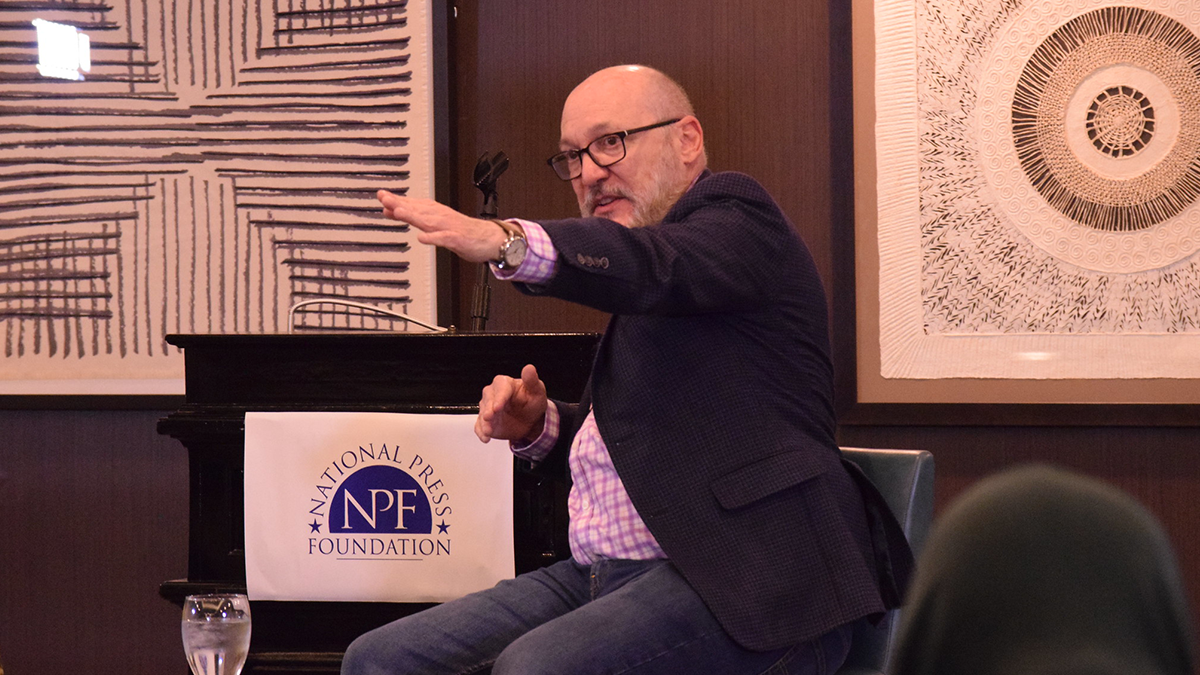
In November 2022, more than 70% of New Mexico voters agreed to amend the state’s constitution to spend $150 million a year on early learning for most children in the state. Early learning and child care have been intensely debated issues over the past few decades as states, municipalities and individuals argued about who was responsible for providing that care. But advocacy groups like New Mexico Voices for Children insisted that quality child care is an incredibly important cornerstone of any community in any society. Sharon Kayne, communications director for the advocacy group New Mexico Voices for Children, outlined the path to the historic approval for the Future of the American Child fellows in McAllen, Texas. [Transcript | Video]
5 takeaways:
➀ The U.S. lags behind other developed nations in “cradle to career” education policy. The last time the US had a federal child care policy was during World War II, Kayne said. Because men were going off to Europe to fight, women were needed to work in the factories. Today, though most men aren’t on battlefields, many mothers must work outside of the home. According to the Bureau of Labor Statistics, among married-couple families with children in 2021, 96.5% had at least one employed parent, and in 62.3% of these families, both parents were employed.
➁ Advocates must be ready to play the long game for children’s issues. New Mexico Voices for Children won a grant from the W. K. Kellogg foundation in 2009 by proposing several main strategies, Kayne said. The priority was to educate lawmakers, opinion leaders and the business community about the value of high-quality early childhood care and education programs. Advocates proposed three main strategies for providing that care: home visiting, child care assistance, and pre-kindergarten. That’s because research has proven that “85% of brain development occurs within the first five years of life,” Kayne said. Building a solid foundation during that period impacts all the other years of learning. Once that message was delivered, the goal was to get everyone operating from the same strategic playbook.
➂ Mastering the legislative policy realm is essential. Kayne said advocates had to identify the most viable source of funding for early education. By 2010, they zeroed in on the Land Grant Permanent Fund, set up by Congress when New Mexico became a state in 1912. It receives money from the extraction of oil, gas and other minerals from public land and Wall Street investments. Every year, per the state’s constitution, 5% of the fund is withdrawn, and it goes to about a couple of dozen beneficiaries, Kayne said. The lion’s share goes to K-12 schools.
In 2010, the fund was worth more than $10 billion—almost double New Mexico’s $5 billion-plus overall budget. But getting the legislature would need to pass a joint resolution to put the measure on the ballot was a long, involved process. So in 2021, New Mexico Voices for Children launched a coalition called “Invest in Kids Now.” And because some people were calling the Land Grant fund a “rainy day” resource, the child care coalition bought yellow umbrellas and had the words, “Invest in Kids Now” printed on them.
➃ Immigrant families are most vulnerable to gaps in early child care. Kayne said 97% of New Mexico’s children are U.S. born. However, 25% of those kids live in immigrant families, which includes the undocumented, those with resident alien visas and green card holders. That means at least one parent is an immigrant. And immigrants may speak a language other than English, which may make it impossible for them to help their children with homework. “It might even make it difficult for them to enroll their kids in benefits programs for which they are eligible,” Kayne said.
➄ The biggest barrier often lies in negative stereotypes about who needs child care. Kayne said that even though New Mexico is a “minority-majority” state, “You hear all kinds of racist and sexist garbage at the legislature during the session, sadly.” Advocates must constantly stress that child care assistance is only available to people who are currently working or looking for work, or if they are enrolled in school. Kayne believes there was a crucial misstep during America’s welfare reform reauthorization of the mid-90s. Job requirements should have been coupled with a child care assistance program, Kayne said, which would have assured that single moms weren’t spending a third or more of their income just on child care.
This program was sponsored by the David and Lucile Packard Foundation, the W.K. Kellogg Foundation and the Heising-Simons Foundation. NPF is solely responsible for the content.