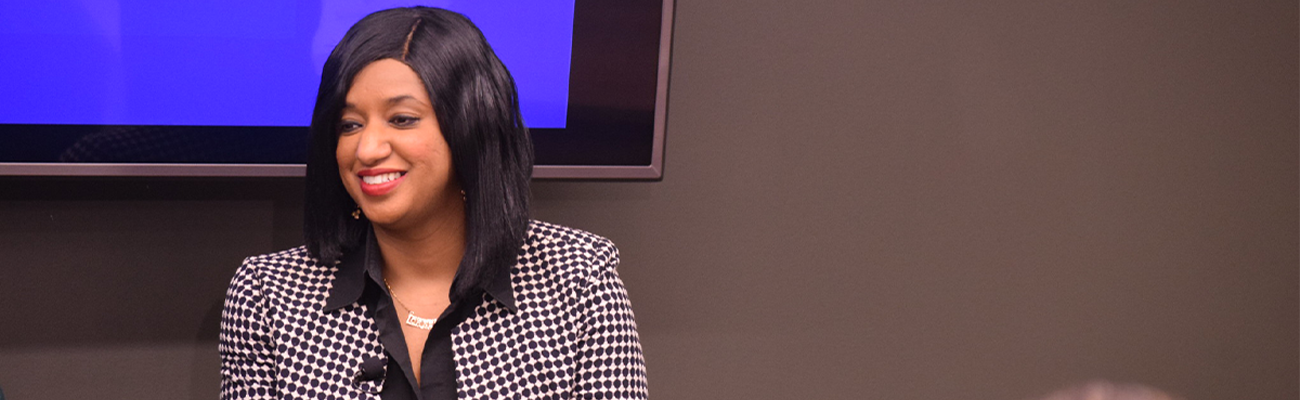
During early career stints as a broadcast journalist, Caresse Jackman learned a lot about thinking deeply about stories. From Jackson, Mississippi, to New Orleans to Nashville – with a stop in between at a Flint, Michigan, station during that city’s water crisis — Jackman was drawn to the analysis and rigor required to yield complex stories.
In her current role as a national investigative reporter for Gray Television’s Investigate TV, Jackman believes any journalist can master the challenge and opportunity of investigative reporting. She offered NPF Widening the Pipeline fellows strategies for taking stories to the next level.
Here are some takeaways from Jackman’s session:
If you build it, they will come.
Investigative story ideas, that is. You have to build them from the ground up, Jackman said.
“You start digging. You start listening to other things that are happening around you. … It’s an investigative mindset that you have to have. And I always say: Anything that can be questioned, can be investigated.”
She advised journalists to make a list of their questions as well as related claims.
Get the hard evidence.
So you think you’re onto something. “Sketch out how you can prove this through people and documents,” Jackman said. “In the end, it’s public records, body camera video, audios, data. If you’re interviewing a woman and she says, ‘The cops came to my door, mistreated me, accused me of stealing when it was in there,’ I have the records to prove it. Find ways to collect data and information to prove or disprove if this is in fact a story. And after you vet that and you get that documentation, you really start digging and collecting information and looking for patterns.”
It may not be nefarious — but you may still need to investigate.
Jackman unpacked her investigative series on neglected Black cemeteries to illustrate this point, “Some things are systemic. And that’s also a big part of investigative reporting. A lot of the issues that I deal with and I look into are systemic issues. Just because you don’t have one person to accuse of doing something or holding accountable doesn’t mean that you don’t need to do the story.”
Sourcing pays off big time.
When you care about the people you’re covering, Jackman said it gets a lot easier. Sources can be anybody from someone that works in a police department to a community activist.
“There are still people that I talk to in Mississippi from my early years on. And that was 16, 17 years ago that I still keep in contact with. Whether it’s through a social media post and I tell them happy birthday so they remember who I am or they might text me and be like, ‘Are you going to be in Mississippi anytime soon? There’s this story that I think somebody needs to cover.’”
Access the full transcript here.
This fellowship is funded by the Evelyn Y. Davis Foundation and the John C. and Ethel C. Eklund Scholarship Fund. NPF is solely responsible for the content.



 Reload document
 Open in new tab