For people living with rare disease and their families, information truly is power. The struggle to identify complex illnesses, and the challenge of finding effective treatments, requires constant knowledge-seeking. And quantitative information about that journey can also yield better policies for those dealing with extraordinary medical challenges.
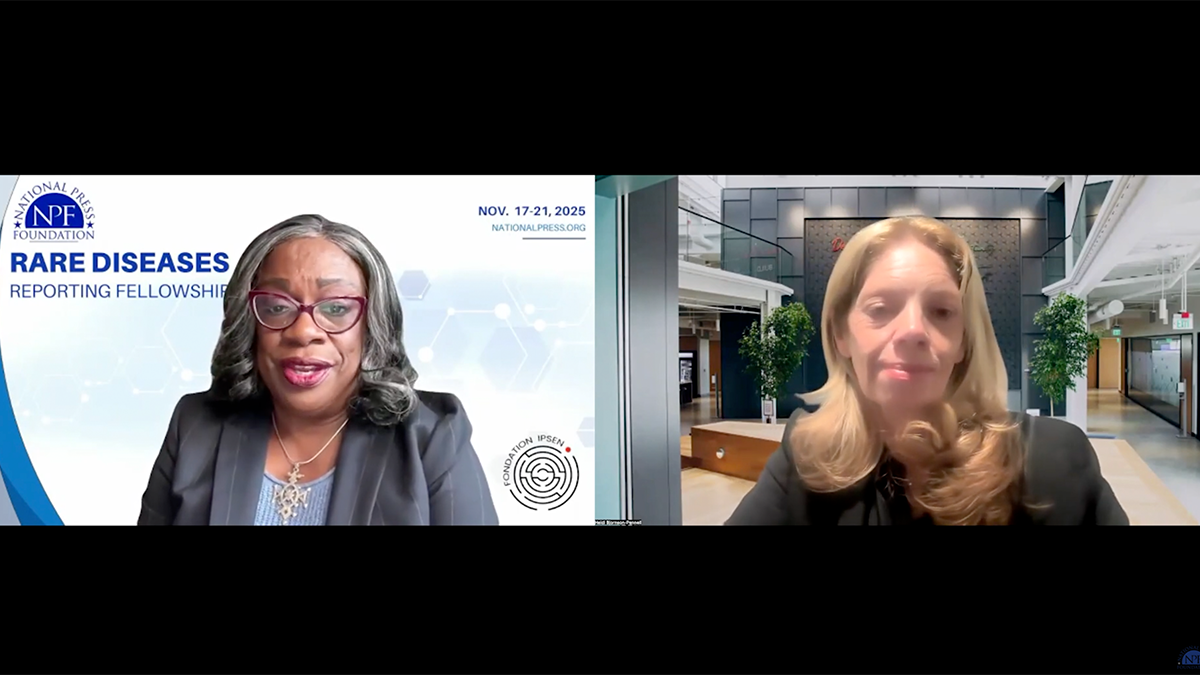
NPF Rare Disease Reporting fellows heard from researchers who lead two projects designed to gather data about navigating life with a rare disease, and how families and caregivers are affected. Jessie Dubief, the social research director for the European rare diseases organization EURORDIS, briefed the journalists about the Rare Barometer survey initiative that has amplified the voices and experiences of thousands of rare disease patients and their families from over 100 countries since 2016.
Darby Gavin, senior community engagement manager with the National Organization for Rare Disorders (NORD) also briefed fellows. She oversees their Living Rare Study launched in October 2024, the first ever large-scale study in the U.S. examining the experiences and challenges of people impacted by rare disease.
Here are highlights from that session:
Rare Barometer provides worldwide snapshot
The EURORDIS initiative casts a wide net for insights and opinions, Dubief said.
“We transform those experiences and opinions to facts and figures to feed the advocacy work of the rare disease community and to raise awareness on what it means to be living with a rare disease.”
They do this by conducting one to three surveys annually. Dubief said that each survey’s global reach is what lends authority to the data.
“In this panel we have 23,000 people living with more than 2,000 rare diseases in more than a hundred countries,” Dubief said. “What is really important then for us is that we share the collective results not only with the survey participants, but also with the patient organizations, the decision makers and the wider public, while keeping the individual information very confidential.”
The diagnostic odyssey is longer for children
In 2022, Rare Barometer’s largest survey to date helped fill the gaps about how long children and their families wait for a confirmed diagnosis.
“This average time of five years from the first symptoms to a confirmed diagnosis, this is something that we heard about, but we never confirmed that with robust data.”
Survey respondents said that most of this that journey is spent inside of health facilities.
“Once people go see a doctor and have a first medical consultation to know more about their symptoms, it’s 90% of this time, more than four years that is spent looking for a diagnosis. And we have also looked at when people have already the initial diagnosis, the first symptomatic treatment or are referred to a center of expertise. And this is something also that changes, for instance, in different countries or for different diseases. So what we can provide is individual, specific results for those countries or diseases.”
The Living Rare Study heightens understanding of Americans with rare diseases
Though the best research and treatments are arguably available in the United States, Gavin said there are still perception gaps that NORD hopes to amplify by gathering detailed information.
“We have a call center that receives thousands of calls and emails a year and we are consistently exposed to the challenges that our community members face. But we didn’t have the data to help others outside of the rare disease community understand what it meant to be ‘living rare.’ And we didn’t have the ability to really convey the impact to key decision makers, like policy makers and lawmakers. So because of that, we embarked on this project. We recognized that in order to be really effective in our advocacy efforts, we needed to be able to have data to bolster everything that we’re saying to members of Congress and to state legislators.”
Gavin noted all the areas they measure:
- Access to treatment
- Diagnosis
- Navigating the healthcare system
- Quality of care
- Insurance coverage and denials
- Burden and impact
“We ask questions related to emotional, physical and financial health. And lastly, we ask questions about impact on daily life, questions about quality of life, about employment, and about basic needs.”
The goal is to foster better understanding of how all-encompassing the rare disease journey is, Gavin said.
“It impacts your educational attainment both as a patient or as a caregiver. It impacts your financial health, your emotional health, your social health, your relationship with your spouse, with your friends, your ability to participate in all of these activities that exist in society for people designed for people who are not impacted by rare disease.”
Access the full transcript here.
This fellowship is funded by Fondation Ipsen. NPF is solely responsible for the content.


 Reload document
 Open in new tab