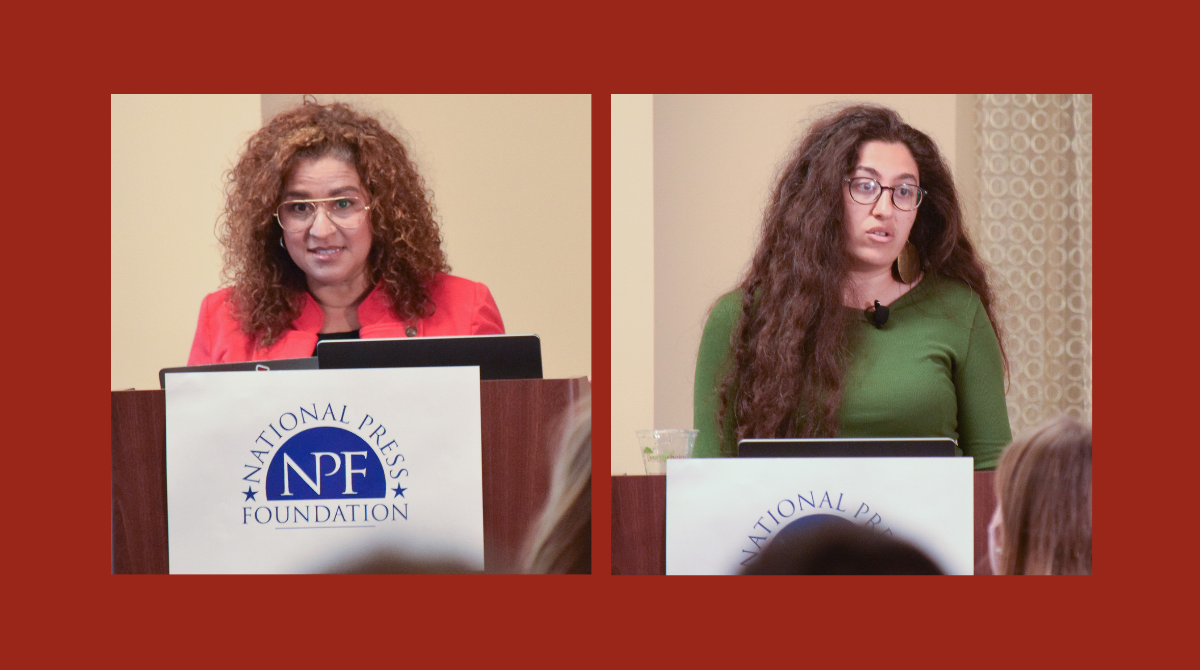
When Russian spies broke into the non-public side of voter registration systems in a few states in 2016, the federal government stepped up its election security game, Will Adler, a senior technologist at the Center for Democracy and Technology, said. Yet when the 2020 election proved to be well-run and secure, many tried to say it was rigged. Adler and Emma Llansó, director of the Center for Democracy and Technology’s Free Expression Program, spoke to Paul Miller fellows about election security and fighting disinformation. [Transcript | Video]
5 takeaways:
➀ Election security in 2022 and 2024. The fact that 2020 faced relatively weak foreign attacks doesn’t mean the same will hold true for 2022 and 2024 elections, Adler said, but he believes “domestic threats are greater.” “Steve Bannon, on his podcast, has been trying to recruit people to get involved in election administration at a local level…Now that we have lots of people who are getting involved in elections almost entirely motivated by false information, I think that’s really dangerous, but I think it has a potential to be even worse in 2024,” Adler said, because of election deniers running for governor and secretary of state in a number of states.
➁ “Election officials are just woefully underfunded,” Adler said. “There are computerized voter registration systems, voting machines, ballot tabulators. Many of these are computers that are running on … Windows from 2002 that’s, like, running on Pentium IIIs, and the software hasn’t been updated in 10 years because to update the software, you have to get approval from the federal government and you have to get the vendors to sign the stuff, and it costs a lot of money,” he said. Even so, it’s more accurate than paper ballots, but he said Congress should provide more money to election officials.
➂ Distinguish good election audits from bad audits. “One of the big lessons from 2020 is that an election can be really well-run and really secure, but if you have people with really big megaphones saying that the election was rigged or that there were huge security problems and that misinformation spreads really quickly and people tend to believe it, then it might not matter how well-run and secure it is,” Adler said. Post-election audits are one of the best ways to provide evidence that elections are secure, he said.
According to a report from The Brennan Center, a good audit should be transparent, follow pre-written and comprehensive procedures, be conducted by competent, experienced, unbiased experts and leave ballots and equipment under the control of election officials. A good audit should also establish and test clear hypotheses and maintain a clear chain of custody for materials, according to the Election Assistance Commission. Adler said the Center for Democracy and Technology encourages risk-limiting audits, which provide statistical assurance that the election outcome was correct by examining a randomly selected subset of ballots.
➃ Women of color political candidates are at greater risk of targeted disinformation. Since the 2020 election, Llansó has been doing research into how women of color political candidates experience disinformation online, including the hate, harassment and disinformation targeted at them. She said a report will be coming out in October with data and recommendations on what measures could be put in place and how companies can make it easier to manage the disinformation directed at them. If there is systematically worse disinformation and harassment directed at women of color trying to participate as political candidates, those are efforts to exclude them from representing people in our democracy by harassing them into silence, Llansó said. “It really is corrosive to what we think of as having a representative democracy. If you have particular demographics systematically excluded from participation, you’re never going to have representativeness.”
➄ Journalists – like independent researchers – can help rebuild people’s trust. The Center for Democracy and Technology urges social media companies to be more transparent about how they’re operating, Llansó said. They found that a tenth of users believe they’ve been shadowbanned, which is when people believe their online posts are covertly being hidden or taken down by social media companies. “Folks from different political backgrounds, ethnic backgrounds, gender identity backgrounds all having different stories of like, ‘I think the companies are out to get me and my viewpoint.’” Whether it’s academic researchers, journalists or civil society organizations, she said that having data be more accessible is part of how companies can start rebuilding some of that trust around what’s happening on platforms.
Help support the Paul Miller Fellowship at nationalpress.org/donate. NPF is solely responsible for the content.