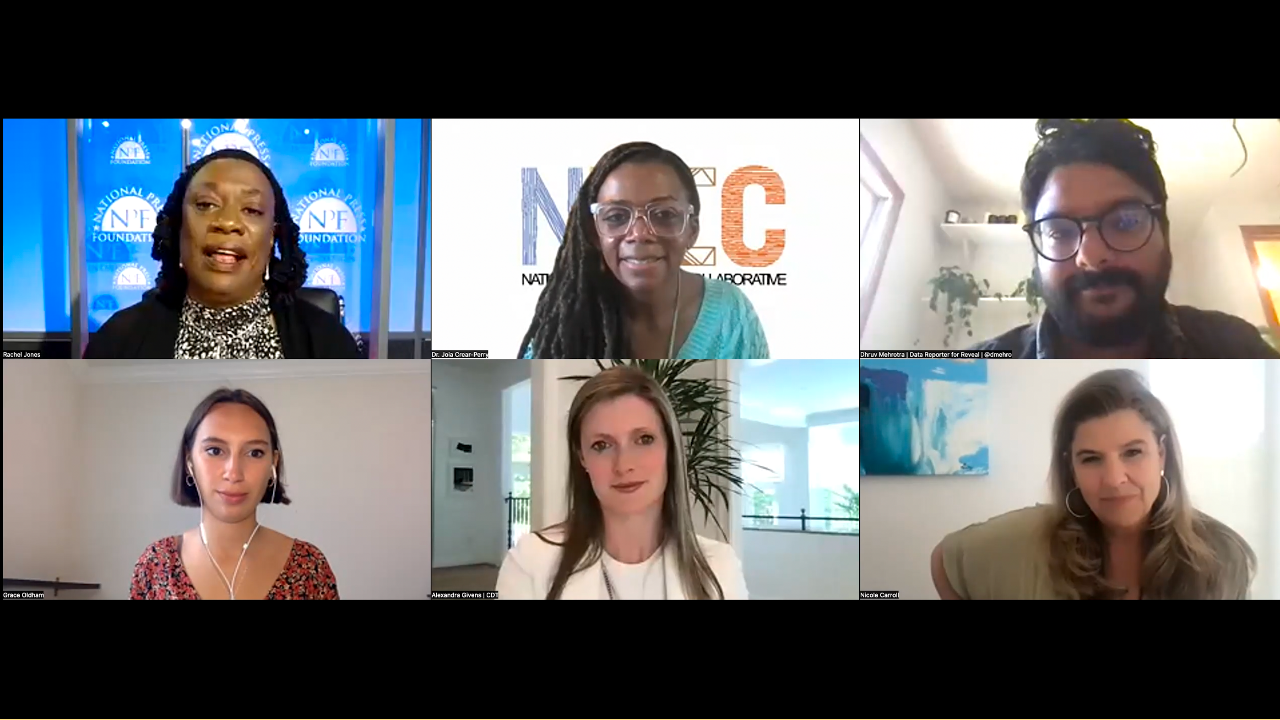
After the Supreme Court Dobbs ruling overturned Roe v. Wade, news outlets published a slew of stories about period trackers and data privacy. Six months later, Jordan Wrigley of Future of Privacy Forum, Kaiser Health News correspondent Rachana Pradhan and Dr. Jamila Perritt, president of Physicians for Reproductive Health, talked to “Your Body, Their Data?” fellows about future coverage. [Transcript | Video]
5 takeaways:
➀ “There is no such thing as raw data,” said Wrigley, who specializes in health data. “We make choices about how we structure data, from beginning to end.”
There is already a medical knowledge gap regarding women’s health. After Dobbs, “suddenly the landscape got a lot more complicated,” Wrigley said. Dozens of clinical trials related to pregnancy, abortion or menstruation were withdrawn, she said, and data people had shared “was suddenly dangerous and possibly weaponized against … people who menstruate, people with bodies that may be vulnerable to abuse of that data.”
“Now, how we structure data has to change in this new landscape to protect the people we want to protect.”
Perritt noted that doctors must think about data traveling “upstream and downstream.”
“We’re doing lots of work talking with providers about medical record documentation because in the same way that we see tech companies turning over their data wholesale to the state and the carceral system, we are seeing hospitals … just copying the chart and sending it over” when subpoenaed, she said, noting that Physicians for Reproductive Health discuss what goes in a patient’s chart and how doctors can understand potential harms.
➁ Methods of abortion are changing, where does the tech industry come in? Google recently announced it would delete location history when people visit abortion clinics, but “how many people still get abortions at physical abortion clinics?” Pradhan asked, noting that data shows the majority of abortions are through medication. The FDA also finalized a rule change to allow medicated abortion through more pharmacies and mail-order.
“If you’re picking up medication from a pharmacy, are you going to be protected? The answer is no,” Pradhan said. “Even if you go up to an abortion clinic, all the data feeding into that is still visible. And if you track your periods on an app, if it shows you have a missed period, if you’ve used social media to message people, if you’ve Googled anything related to these procedures, all of that could be used against you.”
She said a ripe question for journalists is what the tech industry will do about these issues without government intervention.
➂ Policy has not yet addressed data brokering. Wrigley said ideally, data brokers “would operate similarly to how researchers operate,” de-identifying and anonymizing data. However, she said there is nothing currently ensuring data brokers operate in this way, even if brokers have ethical reasons to do so. “Data brokers are a big liability, in the data flow system, around health,” she said.
➃ Abortion funds can be helpful sources for reporters. The National Network of Abortion Funds can provide quotes and anecdotal information about demands as well as precautions they are taking. “Privacy is of utmost concern for them,” Pradhan said. She said their work has skyrocketed since the Dobbs decision.
“Don’t call the helpline when you’re trying to get information for your story,” Perritt said. Funds won’t connect reporters to individual patients, and it may take time for them to respond to reporters. Perritt said to focus on minimizing risks for clinics, people seeking care and people funding care.
➄ Be careful with language. Perritt warned against using the term “elective” abortion and said to use spontaneous abortion or induced abortion, whichever is accurate to the situation. She also asked journalists to think about “ways that you can be broader and braver in the way that you are talking about gendered language.” However, it can be important to specify gender as it relates to gendered oppression. Person-first language can also reduce the stigma against people providing and receiving abortions.
This program was sponsored by Arnold Ventures and Medtronic. NPF is solely responsible for the content.