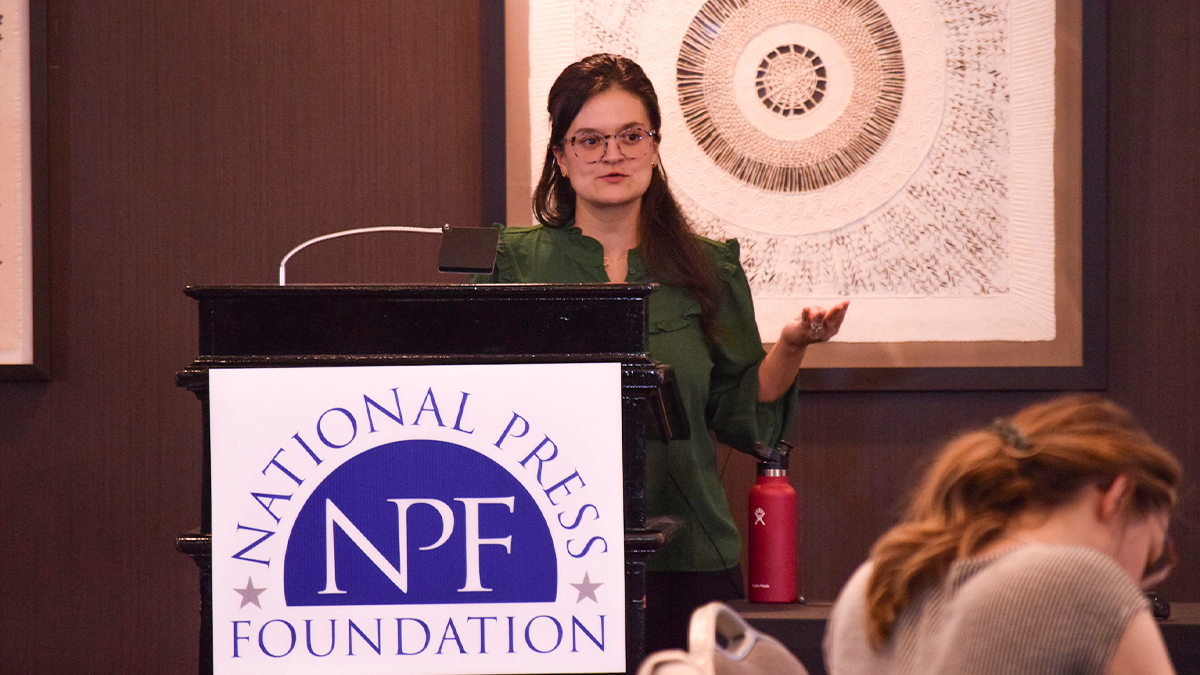
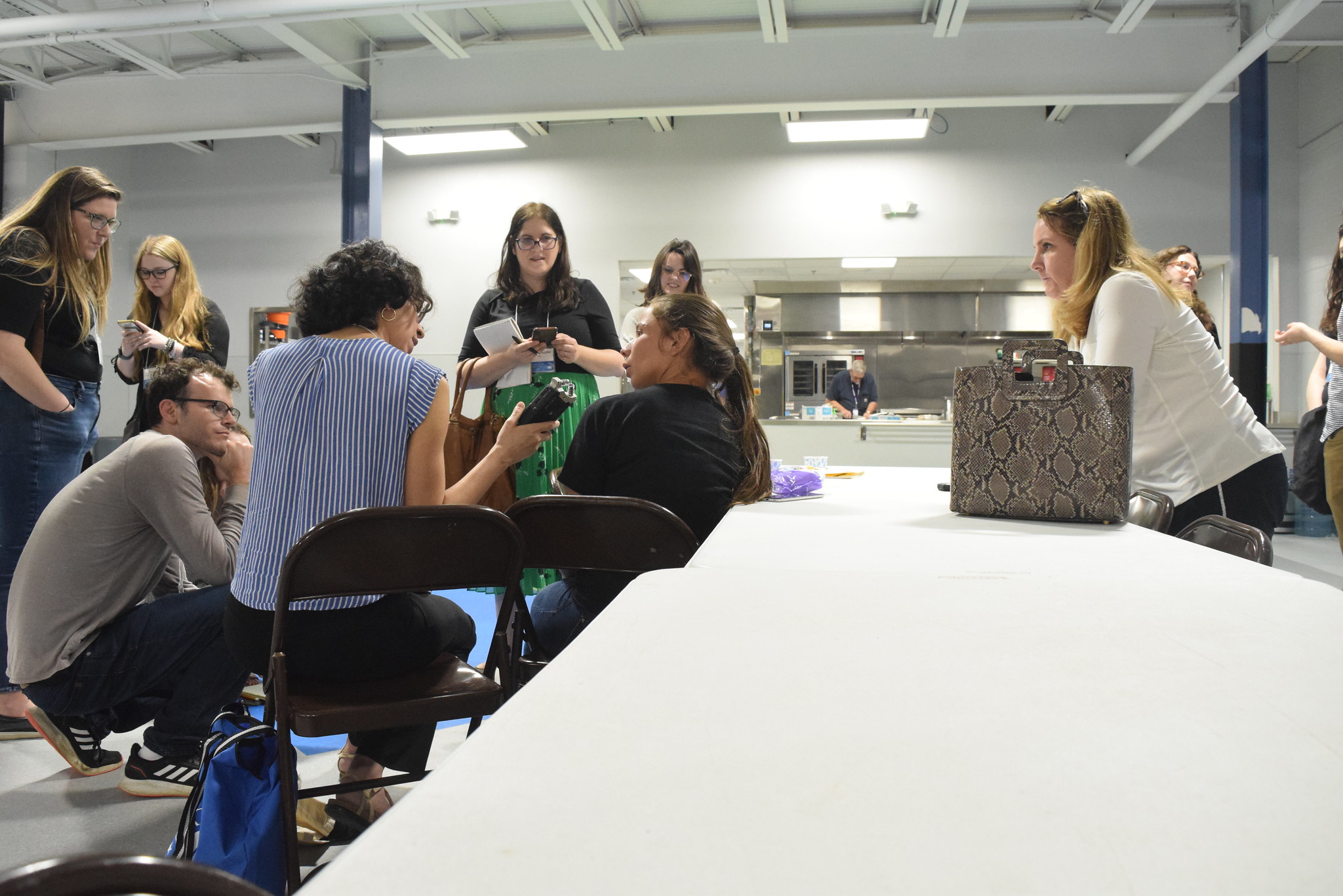
Sister Norma Pimentel says she confronted the “immigrant reality” back in 2014 because overwhelming numbers of families with young children were arriving at border cities like Brownsville and McAllen, Texas. They were more than Border Patrol officials could handle, and as Sister Pimentel watched children being separated from parents and crowded into cramped offices, dirty and crying and scared, she had to intervene. Since then, Sister Pimentel has emerged as a leading advocate for families at the U.S. Border, in her role as Executive Director of Catholic Charities of the Rio Grande Valley. She says visitors who join her on tours of detention facilities usually leave with a different perspective on immigrants. She told NPF fellows in McAllen that their job is to present an accurate view of their reality. [Transcript | Video]
5 takeaways:
➀ You’re lucky if you can’t imagine what it’s like in a detention center. For Sister Norma, one image is seared in her memory from that day in 2014. That’s when she arrived at a Border Patrol detention center and saw rooms with big glass windows filled with children. “You see them all looking through their glass window, all of the little eyes, all looking at us because we were standing pretty much in the middle as they were showing me the place. And all these little faces full of tears, just looking.”
Pimentel asked officials if she could go in and pray with them. “So they looked at each other and they said, ‘Well, how can you really say no to a nun that wants to pray, right?’ So I got in. But I mean, let me tell you, for me getting in there has been the most difficult thing I’ve ever done in my life.” The tired, anxious children clung to her, and all of them were gray because the mud and dirt they had slogged through had dried on their skin.” As they begged for help, Pimental said it was a defining moment. “Having that experience and being there with them caused me to never forget my mission, to help children, to help those families because it’s not right. My God, we are the United States of America, the most powerful nation in the world and that’s all we can do?”
➁ Before placing blame, look inward. Pimentel said it would be too easy to accuse the Border Patrol for conditions at the Border. But at the end, “it’s our fault, all of us, because we failed those children. Why didn’t the National Red Cross set up shop and have them all in better conditions? It’s all political. There’s always a reason why not. I couldn’t do nothing other than pray with them and cry with them. And they all repeated after me, ‘Please, God help us.’ ”
That scene affected Border Patrol agents, too, “Now they were looking in and they too were crying. When I walked out of there, the agent in charge said, ‘Thank you, sister. You made us realize they’re human beings.’ ” It’s too easy to get caught up in laws and policies and procedures and neglect what’s most important, Pimentel said–who we are as human beings. “We lose sight of our humanity and our responsibility to one another,” Pimentel said.
➂ Whoever has the microphone gets to shape public perception about immigrants. That’s why Pimentel said it’s important for advocates like her to invite legislators and businessmen and community leaders to visit the border, to interact with aid workers and families. The prevailing anti-immigrant sentiment is to portray them as invaders or criminals, Pimentel said. “Whether it’s true or not, it doesn’t matter….if I say it enough, it becomes a fact. So today we are living in a new age, the age of other than truth. It’s what I say. And if I say it louder enough or many times, it becomes the truth and it becomes the facts.”
➃ Immigrant children, like all children, need the time and space to play. “Kids act out what their parents are caregivers are experiencing,” Pimentel said. “And so when they arrive to the center…You could see in their faces and how they’re dealing with their present reality.” But when they enter facilities like the Humanitarian Respite Center in McAllen, there’s a shift. “All of a sudden, you see them walking to this…..space that is to play. You see their faces change totally. It’s like there’s a transformation. It’s like, as if it’s magical.”

➄ Accurate reporting can help the public perception of immigrants. Pimentel said she welcomes interactions with media because she can help provide proper context. “I find myself sometimes battling with the media to try to bring out the true meaning of what is happening here at the border, the actual reality, because you capture sometimes things that are in my way of looking, doesn’t capture the truth a hundred percent.” As long as journalists report on both sides of the story—concerns about illegal immigration but also about the conditions at the border—then they’re doing their job correctly, Pimentel said.
This program was sponsored by the David and Lucile Packard Foundation, the W.K. Kellogg Foundation and the Heising-Simons Foundation. NPF is solely responsible for the content.