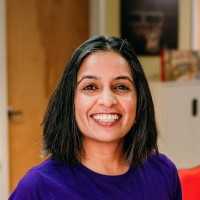
Editor-in-Chief and CEO of Charlottesville Tomorrow Angilee Shah told NPF’s Widening the Pipeline fellows that success isn’t getting accepted at the LA Times – which she tried on multiple occasions – or getting stories published by top editors.
“Success to me is, do the communities I cover grant me that ability to lead, grant me that ability to tell their story? Do they do something with that story? That’s success and we don’t talk about it.”
“So that was a really a huge shift in my brain over I would say just the last five, seven years,” she said.
As a child of immigrants, Shah said her parents didn’t want them to struggle the way they did, and that came with the pressure to be successful.
“And going into a field, journalism to them was trying to become a rock star. It’s like, ‘Is that really the life that you want here? Is that really the life that we saved and scraped for so that you could have?’ So what is success? As a kid of immigrants twice over, success to me was big media. It was national media,” she said.
But when she graduated college and didn’t land a job at the LA Times, she considered it a failure. Her first job was at a publication called AsiaMedia based at UCLA. That job launched her into international news while learning the history, languages and politics of Asia. After three years, she decided it wasn’t going well: She wasn’t making enough money, she was working at a publication no one knew about and she had an office in a closet without a window, she said. “But looking back, man, it was awesome. It was great,” she said.
After a stint in Asia, Shah said, “That period of international news was sort of the tail end of what I thought I wanted.” She had a realization that if the metric of success is focused on climbing ladders, she wasn’t willing to do it.
Shah wanted to get to know the communities and people she was covering – not be separate from them. She became skilled at empowering more communities to own their media, and thinking differently about who could tell stories.
Shah had the opportunity to join Charlottesville Tomorrow at a “critical moment in terms of what decisions the communities there make about their commitments to civil rights, their commitments to justice [and] their commitments to how these places grow and change,” she said. She was referring to the days in August of 2017 when Charlottesville made international headlines in the wake of violent white nationalist protests and the demonstrations against their presence.
As an editor, Shah tells reporters that anyone can learn to write a good lede and a headline. But if you can build trust, and if you have linguistic, cultural and empathetic qualities, you’ve earned valuable skills.
Access the full transcript here.
The Widening the Pipeline Fellowship is sponsored by the Evelyn Y. Davis Foundation and Lenovo. NPF is solely responsible for the content.