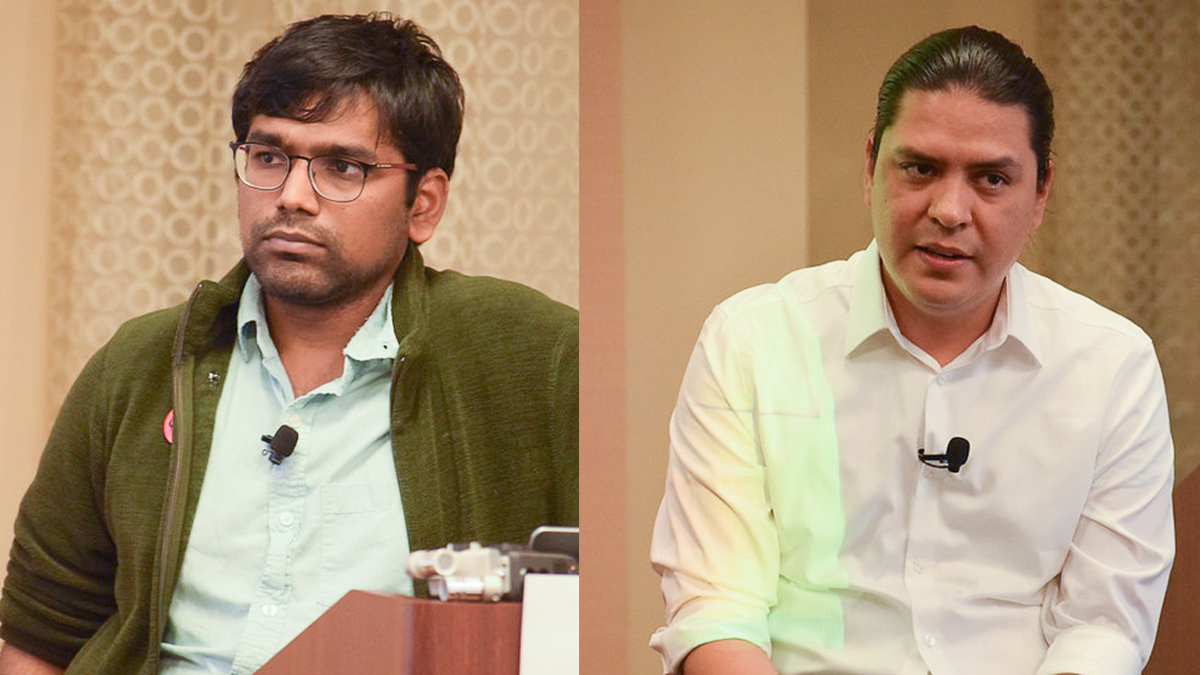
The June 24 Supreme Court ruling that overturned Roe v. Wade has launched a firestorm of debate about the issue of abortion in America. Journalists have the responsibility to report accurately and fairly, fully conveying the effects of the ruling on women, communities of color and on data privacy. The National Press Foundation hosted a 90-minute flash briefing titled “After Roe: Private Stories, Private Data, Public Listening” just days after the ruling that featured the following panelists: Nicole Carroll, editor in chief, USA Today; Dr. Joia Crear-Perry, founder and president of the National Birth Equity Collaborative; Alexandra Reeve Givens, president and CEO of the Center for Democracy & Technology; Dhruv Mehrotra, Reveal data reporter and Grace Oldham, Reveal’s 2021-22 Roy W. Howard Fellow. (Transcript | Video)
5 takeaways:
➀ There are powerful stories to be told. USA Today Editor Nicole Carroll received a box containing a manuscript written by her late mother Judy in January 2022. But she did not start reading it until months later, and that’s when she learned her mother had written the story of her legal abortion in 1975 in Texas, a time when she endured poverty and mental illness. “She hoped that by sharing her experience, others would share their experiences and we could begin to have a conversation about abortion,” Carroll said. Her mother’s manuscript made her think about “all the women, and especially women of color, who didn’t have a voice for so long, who have these stories and couldn’t share them.” When communicating the impact of the Supreme Court ruling, journalists must listen to a broad range of voices, said National Birth Equity Collaborative Founder and President Dr. Joia Crear-Perry. She recommended finding the communities who are asking for access to birth centers, to clean water, to voting rights. “Look for those stories and I bet you’ll find an abortion story because the same oppressions that are keeping them from having their kids in the best schools and having good fresh water are the same oppressions that are fighting them from having access to the full range of reproductive options.”
➁ Examine the role of privilege in the debate. Seventy-five percent of the people who seek abortions are low-income, “And that’s the ones we know about,” Crear-Perry said. Higher-income, privileged people have the resources to go to private clinics for reproductive health options, including abortions, which prevents the data from accurately conveying the scope of who is receiving abortion services. “Black people are not overrepresented in the numbers for abortion because we are the only ones receiving abortions. We’re overrepresented because we’re the only ones who are counted and measured because everything about us is counted and measured inside of the systems,” Crear-Perry said. “That’s why the Roe v. Wade conversation was never about rich people. It’s always about people who need access to public resources.”
➂ The harm behind user data. Facebook and anti-abortion clinics are collecting highly sensitive information on people seeking abortions, according to a recent investigation by Grace Oldham and Dhruv Mehrotra of Reveal. Their reporting focused on “crisis pregnancy centers,” and how information was being compiled about who interacted with them. They visited sites that had Facebook’s advertising technology on it and examined Facebook’s records about what data they kept. Their reporting uncovered a disconnect between what Facebook’s policies stated and how the data was actually being used. The Reveal reporters said the technology can deliver targeted ads aimed at deterring abortion seekers, and that the data can be used to build anti-abortion ad campaigns, and in what Mehrotra and Oldham’s reporting called the “worst-case scenario” – the digital trail could be used as evidence against abortion seekers.
➃ What journalists report about data privacy. Journalists have an important role to play in unpacking the risks associated with user data, as well as helping people understand how to protect themselves, said Alexandra Reeve Givens, president and CEO of the Center for Democracy and Technology. She says that over the past few decades, organizations like hers have called on companies to limit data collection, retention and sharing. She urged reporters to be careful when explaining how readers can empower themselves. There are no one-size-fits-all remedies. Stories about tools like period tracking apps are important to educate readers about guarding their digital footprint, but Reeve Givens emphasized even greater risks. “You need to think about the location access on your cell phone,” she said. “Reminding people to go in and turn off those settings on their devices at the macro level, at the general settings tab, but then also putting limits on individual apps as well.”
➄ Keep watch for what lies ahead. Where data privacy is concerned, Oldham emphasized continuing the reporting that holds organizations accountable. “Monitoring anti-abortion organizations, attending conferences, listening and reading the materials that they’re putting out,” as well as monitoring the future of practical support networks is important, she said. Reeve Givens also suggested closely examining how data privacy cases will be investigated. “I think we are going to see some unprecedented action of people trying to get information and leads to bring those types of cases, and that is a really important story to bring to the forefront.” And she reminded journalists that FOIA requests can be used to find out why law enforcement agencies are asking for private data and what trends they are analyzing.