SINGAPORE — Against a backdrop of uncertain geopolitics and war, forced labor may be one of the most under-reported elements of the sprawling global economy. But the numbers reveal a different and troubling story.
Slightly more than 27 million people have been swept up in sweatshops, farms, factories, commercial sex syndicates and other networks that are reaping billions in illegal profits for their operators, according to the International Labor Organization.
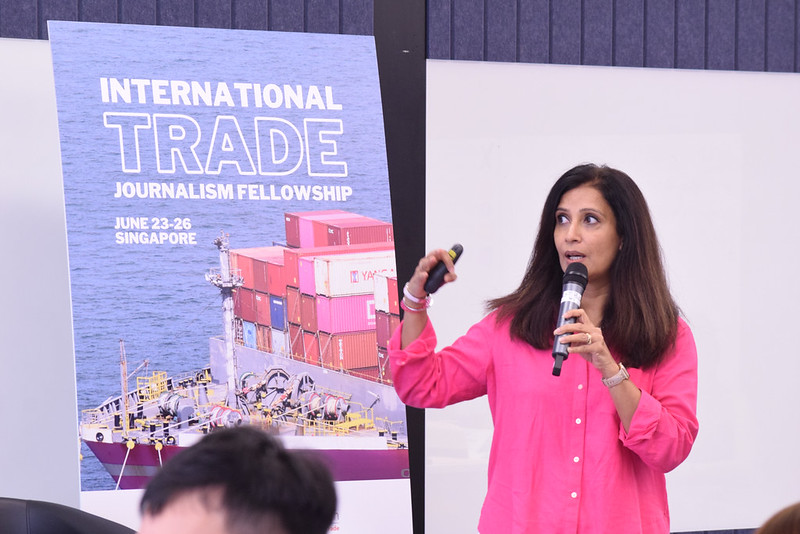
Kavita Chandran, an accredited trainer with Thompson Reuters Foundation and the Solutions Journalism Network (SJN), urged journalists gathered for the National Press Foundation’s International Trade Journalism Fellowship to call attention to the often-hidden misery that churns on beyond public view.

“It’s really important for journalists to go deeper to the source from where forced labor comes in,” Chandran said. “The most important component of international trade is people.”
Chandran referred to the millions toiling in relative slavery who helped generate $236 billion in profits, according to 2024 data compiled by the ILO. The stunning number represents a 37% increase since 2014.
The uncertain conditions–political upheaval and war–shaking the international trade landscape offer an ideal opportunity for journalists to explore the growing crisis, Chandran said. That’s intensified since the Trump administration recently cited forced labor in 60 countries to justify higher tariffs.
The allegations have been rejected by American trading partners as a ruse to reassert an illegal tariff regime struck down by the U.S. Supreme Court in February.
Regardless, Chandran said the administration’s action should trigger a deeper examination of the crisis.
With so much of the forced labor network cloaked in “secrecy,” finding the truth requires a substantial effort.
“It is a very difficult story to do,” she said. “People are a commodity. And unfortunately, if you look at it that way as a business journalist or just a journalist, there is a whole political economy around this sort of forced labor.”
This fellowship is part of an ongoing program of journalism training and awards for trade coverage sponsored by the Hinrich Foundation. The National Press Foundation is solely responsible for the content. Resources and transcripts are available to journalists worldwide.