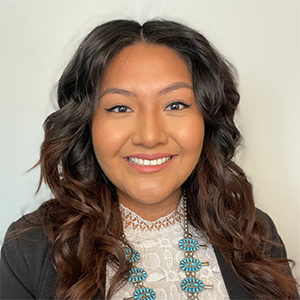
Pauly Denetclaw’s lived experience as a journalist of color is different than some of her reporting peers. For many, a central challenge is being one of a few or the only person of color working for media organizations. But as a political correspondent for ICT News (formerly Indian Country Today,) Denetclaw rarely experienced that scenario in the early years of her career. She told NPF Widening the Pipeline fellows that her first newsroom internship was at the Navajo Times—where most staffers were Indigenous women.
“From there, I went to National Native News, where my supervisor was a Navajo woman and she taught me everything that I know about reporting,” Denetclaw said.
“And when I would go with her on reporting trips, she would be with me. So again, I wasn’t a loner by myself, and she’s so fearless and so incredible, and she would just get in there and be like, ‘Pauly, this is how you do it.’”
Today, Denetclaw reports for ICT, a daily digital news platform that covers the Indigenous world, including American Indians, Alaska Natives and First Nations. She is a citizen of the Navajo Nation, of the Haltsooí (Meadow People) born for Kinyaa’áanii (Towering House People). Denetclaw’s reporting is produced primarily for Indigenous audiences, but she acknowledges another role for her coverage from Capitol Hill.
“There’s a person from the New York Times who came up to me and was like, ‘Oh my gosh, are you Pauly Denetclaw?…I read your stuff because I don’t really understand any issues, any policies that are related to indigenous nations.’ ” The Times reporter continued, “I went to a Senate Indian Affairs committee once, and I didn’t understand anything that was happening there, and I didn’t understand what they were saying. And so, for that reason, I don’t cover the Senate Indian Affairs.”
Denetclaw acknowledges this persistent challenge for some Indigenous journalists who have a clear mandate in their reporting. “I just really want to make sure that folks are aware that to be Native American is a political identity, it’s not a racial identity. We are sovereign Native nations within the United States. We have our own presidents, we have our own councils, we have our own laws, our own governments, we have our own justice systems, we have our own culture language. We are independent nations within the United States.”
Sovereign Native nations have treaties that are their highest laws, and each maintain a nation-to-nation relationship with the United States. But that allegiance does not mean deference to U.S. laws, Denetclaw said. “That’s the issue that happens when people who don’t understand tribal sovereignty report on policies because they don’t understand the very foundation of what that even means. And then we get terrible reporting that likens what it means to be Native American to a racial identity. And then we see court cases like the Indian Child Welfare Act being challenged saying that it’s a race-based law when it’s not. It’s a law that is for tribal nations. It’s rooted in nationhood in the same way that America has a say over the children in this country, tribal nations also have a say in what happens to the children of their nation.”
In November 2023, Denetclaw joined other Indigenous journalists during the first-ever White House commemoration of Native American Heritage Month. She recalls having complex emotions around the visit, which some Indigenous people believed should have been boycotted. For Denetclaw, a surge of pride during the event was tempered by some inescapable truths.
“The White House is the center, the head of a country that committed genocide against our nations, that tried to erase us, that tried to kill us, that actively was in war with our nations,” Denetclaw said. “I think one of the best things that I heard somebody say was that for one night the White House was Native land. And I think that that encapsulates exactly how I felt in that moment.”
Denetclaw and other Indigenous journalists hope to broaden their impact through the re-branding of the Native American Journalists Association. The group is now known as the Indigenous Journalists Association for an important reason.
“We changed our name because we are expanding globally,” Denetclaw said. “We are now expanding into Canada and getting membership in Canada. And folks in Canada do not identify as Native American…Native Hawaiians did not think that they could be a part of our organization. And just a lot of indigenous people who are in the United States but are from other countries, felt as though they could not be a part of our organization because they are not Native American. And so, we wanted to create an inclusive space of all indigenous people and welcoming them into our organization.”
Access the full transcript here.
The Widening the Pipeline Fellowship is sponsored by the Evelyn Y. Davis Foundation and Lenovo. NPF is solely responsible for the content.