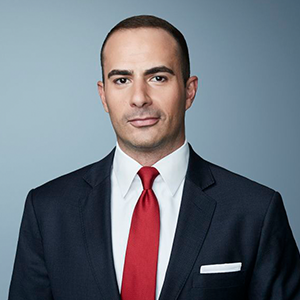
Hearing CNN Anchor Boris Sanchez describe the struggles of his grandfather Jose, who fought the authoritarian regime of dictator Fulgencio Batista in Cuba, is almost as compelling as it must have been for a seven-year-old boy in Hialeah, Florida, sitting amongst the male elders during parties and holidays as his grandfather told vivid stories.
“I’m hearing them talk about history and politics and things that I could tell were very emotionally charged and significant to them, and I desperately wanted to be part of that conversation,” Sanchez told Widening the Pipeline fellows on Feb. 15. “I desperately wanted to impress them with my ideas. I had my own ideas, and I was seven years old.” And though some of young Sanchez’s interests involved “The Simpsons,” he was also obsessed with local news. A Miami news anchor who shared his last name also fueled his imagination, because he got to tell stories for a living. Sanchez decided journalism was not only a way to build a career, it could also help fulfill a vicarious dream of his mother, who’d always wanted to be a writer but who was forced to work in a tin can factory in Cuba.
Fast forward 25 years. “I’m at the White House standing in front of the president,” Sanchez said, “And he’s pointing at me, inviting me to question him the same thing that my grandfather was incarcerated for. It gives me all the feelings, even as I say it out loud. And believe me, I’ve talked to a lot of young journalists, I’ve told this story many times, and every time I tell it, I still get that feeling because it is my why.”
Hanging On Through the Hard Slog
Sanchez didn’t sugarcoat the challenges of starting out in journalism.
“I had to take out massive loans to be able to afford Syracuse University and to complement those scholarships. And I got shipped out to a tiny TV station in the Redding, California market… It felt like where I was doing everything at that station. I was a one-man band. I was carrying the camera, I was running the teleprompter, I was fixing the IT, I felt like the custodian at that station cleaning up other people’s messes. And I was making $17,000 a year in California, where registering your car alone is like 200 bucks. It was back then in 2010. I don’t want to imagine what it’s like now.”
In hindsight, covering everything builds muscle. “I did stories on cows stuck in the middle of the road,” Sanchez said. “I did stories on weird meth crime. There’s a lot of, some guy steals a car and drives it into a house, random sort of spot news. It was also great access for local politics because you could go to a community meeting and there would only be a certain amount of people there. So you could have a conversation with the mayor, the sheriff right away. In a bigger city, that’s much more difficult. So there were a ton of stories that I covered there that were fundamental in my shaping as a journalist.”
Still, Sanchez acknowledges the pangs of uncertainty that can kick in when a career seems stalled and there are few resources and little support from editors. Add to that the thought that your peers are living their best life, and it’s even worse. “I would see my friends on social media, and they were, like, in Miami on a boat with all these beautiful people and all this expensive stuff. And I’m like, ‘I’ve had enough ramen in the microwave this week. What am I doing?’”
Holding firm to his “why” helped Sanchez. “I knew that in that struggle I was building resilience. I was building the capacity to face other obstacles along the way, and that being able to overcome those things made me confident that I could overcome even bigger things.”
After all, Jose Sanchez had spent all those years in a tiny cell in Cuba, fighting for causes much bigger than himself, Sanchez said.
“I actually went to Miami last year because they have a museum dedicated to the Cuban diaspora, and they have a replica of one of the exact cells from the prison where my grandfather was kept called Boniato. And the cell, I kid you not, is roughly from that end of that table to the wall. And he shared it with three men, sometimes four. And because they were political prisoners, they were given different uniforms than the rest of the inmates. And at one point they protested because the other inmates would harass them and they were told, “Oh, you don’t like the uniforms? We’ll take them away.” And they were held naked. Naked… and they were tortured.”
Those stories have fueled Boris Sanchez throughout his life, culminating in his current role with CNN. And he’s grateful for the early career struggles, too. “Fundamentally, having gone through those obstacles early on gave me confidence. Repetition is the father of learning. That’s something I learned from Little Wayne. I kid you not! And it’s true that repetition, that failure and that dealing with obstacles over and over, you come to see the obstacles as gifts, as opportunities. And after a lot of self-delusion, I convinced myself that not only was I capable, but that there was no other choice for me.”
Access the full transcript here.
The Widening the Pipeline Fellowship is sponsored by the Evelyn Y. Davis Foundation and Lenovo. NPF is solely responsible for the content.