5 takeaways:
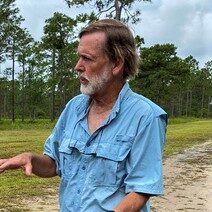
➀ Clear-cutting forests affects more than just the trees. Andy Wood, director of the Coastal Plain Conservation Group in North Carolina, opposes the growing biomass industry that chops down trees to turn them into wood pellets for use as an energy source. In a tour of a forest clear-cut, he pointed to stumps and tangled remains of felled pine trees and other vegetation. “In a true clear-cut, nothing is left behind,” Wood said. “Some scrappy stuff that they didn’t want to mess with that’s been run over by 25-ton pieces of equipment multiple times. Generally speaking, very few animals survive a clear-cut — box turtles, spotted turtles, salamanders. They all kind of get compressed into the soil.”
➁ Forests that have been left alone for now could eventually come under the axe. Wood said that the forests in the South that companies are harvesting for wood-pellet production are “the low hanging fruit of that industry.” In time, he predicts, companies will turn to hardwood forests, such as those alongside the Cape Fear River, which snakes from coastal Wilmington into Central North Carolina and has already risen to engulf the shoreline. “Once those low-hanging forests are harvested, the bottomland swamps will be turned to as a source of wood for wood-pellet production,” Wood said. “… If we’re going to continue harvesting trees, these trees will be on the chopping block, so to speak.”
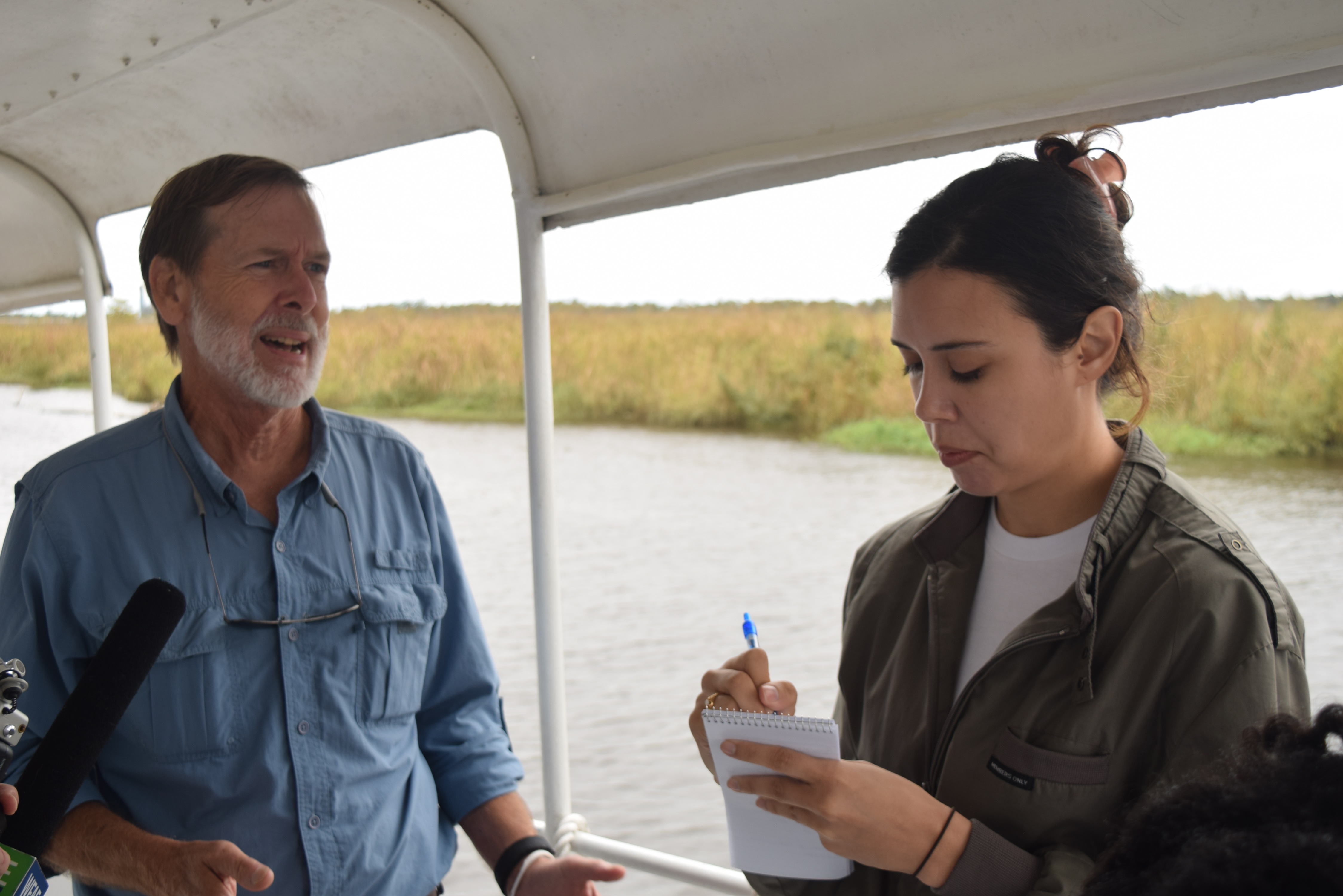
Andy Wood responding to fellows’ questions during the boat tour in North Carolina
➂ With the loss of forests comes the loss of biodiversity. Wood said that Southeastern North Carolina is abundantly rich in plant and animal life. “We have more species of plants and wildlife than anywhere on the Atlantic seaboard, north of Florida,” he said. “We have 23 different kinds of frogs just in Southeastern North Carolina. There’s a few places in Georgia and Florida that have a couple more frogs than we do, but that’s it.” On a tour of the Cape Fear River basin, Wood pointed to cypress trees that are between 200 and 300 years old. That’s what could get lost if logging for wood pellets continues to grow and moves into older forests, he said.
➃ Despite its biodiversity, the forested lands in much of North Carolina aren’t virgin and aren’t good for uses other than wood. Charlie King, who has allowed wood-pellet producer Enviva to source some of its wood from his Fayetteville, North Carolina-area property, said there’s little else that can be done with the land. “This is totally worthless land,” he said. “I mean, that’s why the Army’s over here at Fort Bragg because you can’t really grow much out here. Every known poisonous snake in North America is here, in this county. All kinds of biting insects. In many senses, it’s kind of a terrible landscape — and yet, it is so diverse.” King said his ancestors felled the pine forest to make turpentine. He has sold brush and diseased trees he would otherwise had to have burned to Enviva and is grateful for the opportunity to sell Enviva biomass that would find no other market.
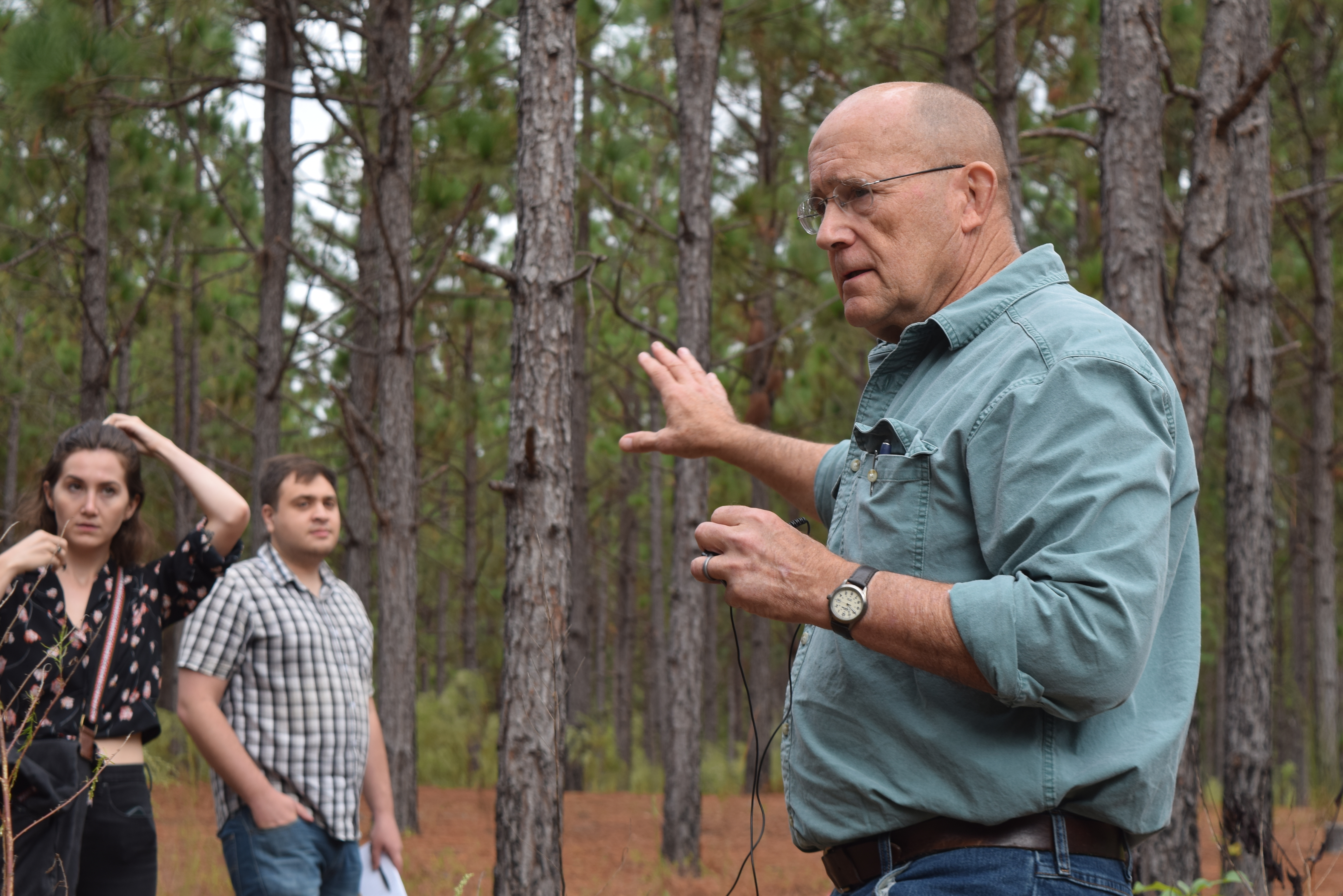
Charlie King talking to bioenergy fellows on his property
➄ Private landowners dominate forests in the South and say they have an incentive to maintain and regrow their trees. King manages his family’s forest land with an objective to keep it in the family. They harvest some timber products from it, but they also restore the forest with native and fire-resistant long-leaf pines. “Some of the forest you’re going to see here this morning is a business investment,” he said on a tour of his family’s land. “It’s a crop. We’re growing something to sell.” He said that prime lumber is sold for higher prices, but Enviva provides small landowners like his family a way to make otherwise unproductive land productive. “We’re not raping the land,” he said. “… We’re restoring every tree that we take down.”
Speakers:
Charlie King, Private Forest Landowner, Cumberland County, North Carolina
Andy Wood, Director, Coastal Plain Conservation Group
This program was funded by the David and Lucile Packard Foundation. NPF is solely responsible for the content.