5 takeaways:
➀ Being big is not a crime. But some actions to make yourself big could be. Jason Furman, former chairman of President Barack Obama’s Council Economic Advisers and now a professor at Harvard University, offered a tutorial on antitrust policy for journalists. In the Gilded Age in the late 19th century, it was Standard Oil and the Rockefellers dominating American industry. Today, it’s Apple, Amazon, Facebook and Google who are in regulators’ crosshairs. But the same legal principals apply. “Monopoly is not illegal. That’s a noun,” Furman said. “Monopolization is illegal. Monopolization is a verb. … You’re allowed to be big but you’re not allowed to make yourself big in any illegal manner.”
➁ A company can cross the antitrust line if it tries to prohibit another company from selling its products. Think of apples and Apple – the fruit and the tech company. “If I want to set up my own Jason Furman store and I have apples that I grow in my backyard and I go to the supermarket and say, ‘Hey, you can only sell my apples. You can’t sell anyone else’s apples,’” that supermarket would likely send Furman packing, he said. But if Apple Inc. goes to a company and says, “If you want to sell iPhones, you can’t sell anything else,” that would be considered anticompetitive. So federal regulators are far more likely to constrain tech titan Apple than “Jason Furman, backyard grower of tasty apples.” Big antitrust cases have also focused on companies that use their monopoly power in one market to gain power in another. For example, in the 1990s Microsoft Corp. was sued for using its monopoly power in personal computer operating systems to gain leverage over internet browsers.
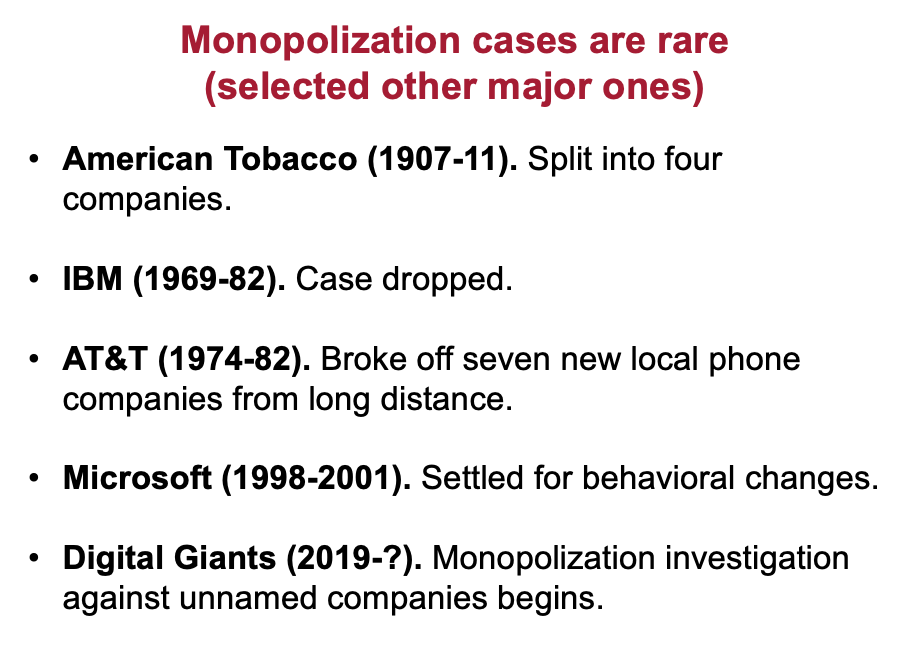
➂ Monopolization and predatory pricing cases are rare. The landmark monopolization case (Standard Oil Co. of New Jersey v. United States, decided in 1911), split Standard Oil into 34 companies. Other cases were brought against American Tobacco, IBM and AT&T, which was broken into regional “Baby Bells.” But many cases stall out, such as the government’s action against IBM. Likewise, major government action against “predatory pricing” — when a company severely undercuts its competitors to drive them out of business — is virtually non-existent. “If you lower your prices for a while, maybe you drive someone out,” Furman said. “But then you start to raise your prices and they come right back in. Or you lower prices and you can’t lower them for long enough to drive them out of business, or you drive them out of business and you can’t raise your prices.”
➃ The nation is now in a major era of antitrust upheaval, with its outcome uncertain. William Kovacic, former chairman of the Federal Trade Commission and now a professor at George Washington University Law School, said that the country has experienced a “perceived permissiveness” in antitrust regulation, as tech giants have gotten bigger and more powerful. Kovacic dates the antitrust animus to the economic meltdown of 2007-2009. “It created pervasive doubts about capitalism and about what on earth business managers were doing,” he said. “How could they have turned the banking system into a casino?” Over the previous 18 months, Kovacic cited “remarkable developments” in antitrust, including public and private lawsuits involving Google, Facebook, Amazon and Apple. Congress and state legislatures are far more interested in antitrust enforcement than they have been in decades, he said. The House Judiciary Committee’s antitrust subcommittee has been active, issuing a major report in 2020 and holding hearings on alleged anticompetitive conduct. GOP lawmakers have issued their own report on how to take on Big Tech. And the Senate antitrust committee is also weighing in.
➄ Europe is a major player. More than 130 countries have competition law systems —up from just 30 in 1990. In the EU and the United Kingdom, there are major proposals for more antitrust regulations. “The U.S. is no longer the capital of antitrust enforcement. That’s Brussels in the European Commission,” Kovacic said. “They have led the assault on tech.” Google has agreed to pay $267 million to settle a French antitrust case, while Facebook, Amazon and Apple are under investigation in either the EU, the U.K. or both.
Speakers:
Jason Furman, Aetna Professor of the Practice of Economic Policy, Harvard Kennedy School and the Department of Economics at Harvard University
William Kovacic, Global Competition Professor of Law and Policy; Professor of Law; Director, Competition Law Center, George Washington University Law School
This program was funded by the Evelyn Y. Davis Foundation. NPF is solely responsible for the content.